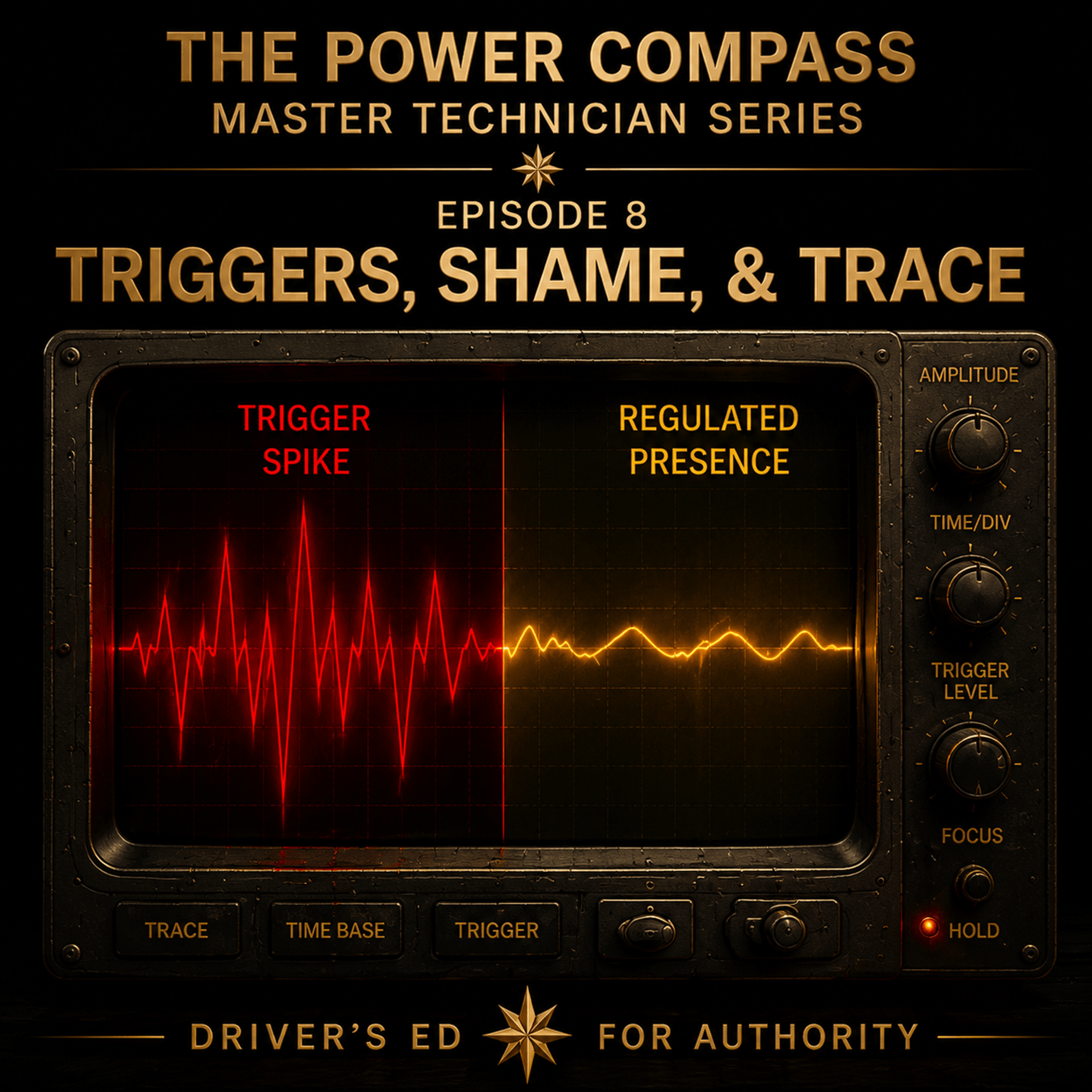
#8 Leadership Triggers, Shame and Emotional Intelligence
The Story
Why do good leaders suddenly snap? Unexamined triggers and shame hijack leadership behavior — and the fix.A trigger is just old stress reminding itself in the present moment. Here's what leaders unconsciously do with their rank when it happens.
WHAT WE DISCUSS We explore how leaders unconsciously use their rank to self-soothe when triggered, the crucial difference between shame and guilt, and a real coaching story of a CEO blindsided by his own team's hidden shame. We introduce TRACE, a five-step method for catching a trigger before it turns into reactive, rank-driven behaviour.
In this episode: • Why a “trigger” is really an old stress reminding itself in the present moment • How leaders unconsciously use their rank to self-soothe when triggered • The crucial difference between shame (“I am a mistake”) and guilt (“I made a mistake”) • A real coaching story: the CEO blindsided by his team's hidden shame • Introducing TRACE: Track, Regulate, Analyze, Choose, Engage • Simple grounding techniques — breathing and small movement — to regulate in the moment • Why naming your triggers to your team can build trust, not weakness
RESOURCES & LINKS MENTIONED • Stephen Covey — The 7 Habits of Highly Effective People / FranklinCovey — https://www.franklincovey.com • Dr Julie Diamond — Power: A User's Guide — https://www.amazon.com/Power-Users-Guide-Julie-Diamond/dp/0996660305
COMING UP NEXT Next time: the polarity between power and love that quietly shapes every leader's blind spots — and why integration, not balance, is the goal.
ABOUT YOUR HOSTS Dr Steve Vinay Gunther Therapist · author · organisational consultant · founder of Gestalt Therapy International. A practicing therapist since 1986, his life experience includes street theatre, clowning, community activism, and a range of businesses — including a vegetarian cafe, printing press, sign-writing business, and food coop. He founded the Northern Rivers Gestalt Institute in Australia and has been running professional therapy training in China since 2012. He has taught in many countries over the last 25 years, is director of Gestalt Therapy International, and founder of Learn Gestalt. He has practiced meditation since 1973 and was Professor of Spiritual Psychology at Ryokan College in Los Angeles. He is author of the bestseller The Woman In Your Life — A Man's Guide to a Happy Relationship, published in four languages. An accredited career counsellor since 1993, he developed a unique system called Career Decision Coaching. His PhD explored the interpersonal dynamics of power with managers across three countries.
Dr Paul Donovan Organisational consultant and trainer · executive coach · author Owner and director of The Change Company, founded in 1999. He specialises in working with senior executive teams — facilitating team building and strategy, coaching, and leadership development. That work often involves Paul assisting executives to pause their transactional and familiar conversations and examine the individual and collective tensions that are not being discussed. His research suggests these "undiscussable" topics are often among the most strategic for the organisation. Paul has worked across sectors including property development, higher education, pharmaceutical, defence, food manufacture, high-technology medical, government, consulting, and finance. He has published several research articles including a chapter in the award-winning Realising Critical HRD — Stories of Reflecting, Voicing and Enacting Critical Practice. He wrote the popular book Bosses Behaving Badly, exploring how power can be applied skilfully by those in leadership positions.
WhatTriggersLeaders #ShameVsGuiltLeadership #HowToRegulateEmotionsAtWork #SelfSoothingBehaviorInBosses #LeadershipTriggers
Speaker 0: So, welcome everyone to the next episode of our Power Podcast. Speaker 0: I'm Dr. Speaker 0: Stephen Aganta with Dr. Speaker 0: Paul Donovan. Speaker 0: we're both experts in power very interested in the topic and uh...we enjoy talking about it. Speaker 0: so today yeah.. We are going be talking about issues to do which shame And to do with triggers. Speaker 0: What's to Do About It? Speaker 0: Because were interested both In introducing ideas The concepts as well as illustrating them and then giving you something that you can concretely do.
Speaker 1: Yes, absolutely! Speaker 1: You know triggers which is the focus of this time together we have today for me one of the most gritty important topics leaders could work with. Speaker 1: I mean it was a lot decades ago. Speaker 1: Stephen Covey said first comes personal private victory than public. Speaker 1: in my mind The private victory is won by a decision to look at one's triggers, Vinay. Speaker 1: That's what I think and...and i-I think it's a big part of how a leader grows from the inside out And its'how a leader ultimately uses the immense power their roles in..in most authentic ,the most powerful, the most effective manner.
Speaker 1: A huge part of this is looking at our triggers and behaving less driven, informed by our triggers. Speaker 1: What do you think? Speaker 0: Yes. Speaker 0: Triggers are something that everyone's familiar with not just people in positions or power. Speaker 0: certainly couples therapy as we all know get triggered in a relationship an intimate And one of the things that I'm often dealing with is what's called a trigger-trigger situation where both people are triggered and then it just kind of arm again.
Speaker 0: Nobody has calm, everything is provoked. Speaker 0: so we're all familiar with that. Speaker 0: certainly part of development not only leadership but any personal development also very much about being aware in which you get triggered knowing to do something. Speaker 1: Shall I just start with what i think could be a useful definition of trigger? Speaker 1: Yes please. Speaker 1: Okay, um A Trigger is Is a moment Where we get unexpectedly Reminded Of a past circumstance where We were Under pressure or stress and in that Moment which is triggered an inverted commas by What someone says In this present day like there's Someone could say something, do something.
Speaker 1: A particular circumstance that might surround you at the moment unexpectedly reminds your brain of a past circumstance and then as result when we get triggered We're in stress. Speaker 1: Our limbic system, a relatively primitive part of our brain compared to the more sophisticated six millimeter neocortex that's going over the top starts to exert often more control over thoughts feelings and behaviors than we would like And we behave in ways That are triggered by the pain or stress That has been triggered by the initial circumstance, but actually our brain is reliving something that's happened some time earlier and And we ultimately end up behaving in ways that are inappropriate for the present moment But make sense In the context of a previous stress.
Speaker 1: How does that land? Speaker 1: What? Speaker 1: how did I go Vinay? Speaker 0: Yeah, yeah. Speaker 0: Well of course as a therapist I'm very interested in this whole topic. Speaker 0: actually back in my early twenties i was studying clowning and theater And had a very interesting teacher who kind of introduced you could say psychological concepts. Speaker 0: He made the distinction between what he called present-time emotion and banker motion which is very relevant if your studying theatre because You know method acting is about bringing up emotions and so he helped us understand that a present-time emotion whether sadness or anger Is your reaction to what's going on right now?
Speaker 0: Where it was what you call the bank emotional. Speaker 0: as you say things do you pull from the bank, and those emotions tend To be more unwieldy they tend to be heavier. Speaker 0: They tend to often be a bit inappropriate to the presence. Speaker 0: So that's the first thing I think of. Speaker 0: The second thing is that a major element, whether it be in a power role or leadership role triggered in that situation. Speaker 0: Or whether being into personal trigger is anxiety and although some people don't identify as being anxious than Some people are more obviously anxious then others.
Speaker 0: I think anxiety Is something we all kind of deal with at the time especially In this triggering situations you're talking about. Speaker 0: Anxiety is very important I think to understand in relation to power.
Speaker 1: Yes, it truly is. Speaker 1: In my experience most misuse of power by leaders Is simply them having the unfortunate experience Of being in an elevated position but feeling frustrated upset getting triggered. Speaker 1: So you've got low rank feelings But your inner position at high-rank And that combination is highly problematic. Speaker 1: That disjuncture, it's highly problematic because what we tend to do Vinay is utilize the rank To give us cover to behave in certain ways so that we can start to feel better again.
Speaker 1: and So In the most obvious example, I can think of right now when a leader uses their rank to bark orders at their team or close down conversations. Speaker 1: They've momentarily got stressed about something they have got triggered by something that's happened in the meeting and they've utilized the rank of their role to unilaterally decide we gotta move on or that we've got to speed up, or that should stop talking about this. Speaker 1: Or the need to dive deeper into it...or analyze something and the leader will then just take over in a sense And doing so disempower others.
Speaker 1: but primarily when they're gaining here is get momentary relief from whatever triggered them. Speaker 1: And so this is where, the anatomy of poor power use. Speaker 1: It's leaders who are being unconsciously prompted from one trigger to another when they get scared or anxious, or stressed about something and then engage in a behavior that gives them momentary relief. Speaker 1: And the behaviour they're engaging is usually one that's made...that they have access to because their'e in leadership role!
Speaker 1: You know it was no different for parents. Speaker 1: we got triggered by some thing happening which may not have anything do with our kids but beacause our kid has difficulty challenging us up until i get into certain age You know, we may yell raise our voice Speaker 0: or Speaker 1: detach ourselves. Speaker 1: Or do something which gives us momentary relief about whatever's causing stress will just behave in whatever context We can where? Speaker 1: We've got the authority to do something that gives us immediate relief and rank gives Us.
Speaker 1: That Rank Gives Us more behavioral options that we Can Do Without Being Called on Speaker 0: Yeah Yeah. Speaker 0: In terms of the psychological term, we'd use the word soothing or self-soothing and certainly if you think about it like as a child is having a child, child becomes distressed then we want to find ways to soothe the child. Speaker 0: I mean some parents will soothe their child by these days giving them screen on something. Speaker 0: but really what's necessary? Speaker 0: that they need?
Speaker 0: calm down in the best kind calming being emotionally present. Speaker 0: now given many of us don't experience that in childhood when we're distressed, then our own self-soothing mechanisms might be any number or what would call creative adjustments which might be disassociating all sorts of things to cope with the stress and anxiety.
Speaker 0: And as you say if your in a position for power Fundamentally, what we're saying is that the mechanism underneath them. Speaker 0: Is this kind of self soothing? Speaker 0: and a lot of leaders can get away without Recognizing things that's going on. Speaker 0: they think well This is appropriate or I'm under boss saw these people are stupid Or whatever. Speaker 0: it isn't. Speaker 0: not really be looking at themselves. Speaker 0: So what? Speaker 0: We're talking about here And in many other things were discussing about power is the willingness of leaders to look at themselves, to look their own internal dynamics and behavior.
Speaker 0: And be willing step back review it open doing something different because that's trouble. Speaker 0: a lot of leaders become very rigid fixed in these kind of patterns. Speaker 0: often if you ask them they're anxious probably say what are talking about? Speaker 0: They'll be insulted or something. Speaker 1: yeah this That's right. Speaker 1: They sometimes don't even know they're anxious, it's evidence of their lack of self-examination. Speaker 1: and so this is where I think as the richest overlap between leadership in therapy.
Speaker 1: And you know many leaders would balk at the idea what do i need to go To a therapist? Speaker 1: become good leader like What? Speaker 1: You Know Like It can seem an almost crazy idea. Speaker 1: And I'm not suggesting that everyone needs to necessarily go to a therapist, but the work one does with a therapist when you're looking at what's triggering you and how...and your taking responsibility for your triggered behavior? Speaker 1: Yeah! Speaker 1: That's also the work of leadership.
Speaker 1: If we've got more power available to us through the roles that we occupy, then we must step up being prepared to do our work on triggers. Speaker 1: And if not will just become all of other leaders who have poked a finger at and said look at this jerk you know aren't they ridiculous? Speaker 1: They're behaving so badly! Speaker 1: Before we knew it. Speaker 1: wear that leader And what I say before we not, We don't know it usually. Speaker 1: It happens and we're unaware that we've become that leader simply because of the unwillingness to win the private victory first at least concurrently.
Speaker 1: so yeah there's a very important overlap here.
Speaker 1: You know, Vinay that's one of the reasons why you and I love talking about power because if you're going to be in roles with more power then it is a great trigger. Speaker 1: In effect just start doing this work. Speaker 1: It'a flagged. Speaker 1: say you better stop doing these works Because If don't as demands your role increase will get under pressure And you'll get triggered with all your past experiences of stress. Speaker 1: They're just going to continue to re-get retriggered and then You'll get into these compensatory reactions, which will almost certainly Mean you or be engaging in aren't in terrible misuses of power?
Speaker 1: Exactly Speaker 0: So let's talk about the role of shame here because we talked about anxiety. Speaker 0: now The roller down would talk about shame. Speaker 0: now shame is a a very big topic, it's something. Speaker 0: although people may recognise some degree of anxiety I think there is less recognition or shame in the role that plays. Speaker 0: Partly because you could say I'm with most uncomfortable experience and generally we all have certainly my own personal experiences. Speaker 0: but nobody wants to feel ashamed.
Speaker 0: People do anything to not feel it and certainly, not recognize that. Speaker 0: And yet along with anxiety It's a kind of a core driver. Speaker 0: So maybe we can just talk about this? Speaker 0: The first thing I think is good To talk about Is making the distinction between shame and guilt Because sometimes people use those words interchangeably But they actually are different. Speaker 1: Yeah They ARE different! Speaker 1: Um...I've had the experience where i have been overcome shame at certain moments.
Speaker 1: Most of us have, haven't we Vinay? Speaker 1: And and you know one of the distinctions is guilt might be I've made a mistake. Speaker 1: Shame is way more global it is. Speaker 1: i am a mistake It's I can't...I'm utterly unworthy! Speaker 1: I am inadequate..i'm not enough. Speaker 1: and sinking into that Experience and one can you know like you and I have talked about the shame dungeon because it can encapsulate. Speaker 1: You and hold your you can circle around in shame sometimes, and shame can by nature of itself become a very disempowering experience whereby we don't even no or don't?
Speaker 1: We consider ourselves as not having this strength to climb out at the same itself. Speaker 1: so we're trapped And you know, when we get uncovered to behave badly. Speaker 1: It's one thing that say I've behaved badly but it is another things. Speaker 1: think oh my God! Speaker 1: I am so wrong...I'm so wrong. Speaker 0: Yeah well thats why leaders don't want go out late generally. Speaker 0: Nobody really does and certainly as you say in a leadership position of the power You can change focus or do somethings move away from feeling your shame.
Speaker 0: I mean, we all do that. Speaker 0: It's just it sort of exaggerated by the leadership and the power issue. Speaker 0: And i guess something else That i wanted to say about um shame is that Often people feel shame or triggered into shame By the behavior of someone who has power over them a teacher Or a boss or something Who can shame them? Speaker 0: Say that was this stupid thing you did You know. Speaker 0: how could you make that mistake? Speaker 0: You know, I don't really want you part of this meeting.
Speaker 0: So there's lots of ways that people can use power to shame others, you know inadvertently but sometimes intentionally. Speaker 0: however what's interesting i think in this context is that even in a leadership position you can still experience shame. Speaker 0: so for instance uh if you give an order and oh i want you to do this and the person maybe does a passive aggressive thing they'll be like yes! Speaker 0: And then As a leader, it's kind of very embarrassing to be nagging an employee and you start feeling angry or angry because they're not doing what you want.
Speaker 0: Or sometimes the sassy employee can make a sharp retort that a lead is not really ready for And kinda gets in there despite the toughness or the protectiveness as role. Speaker 0: Yes! Speaker 0: There's this shame reaction when someone get shamed The first thing they tend to do is, they want a shame back. Speaker 0: So that's where you get in shame cycles with couples very badly but also this power differential. Speaker 0: so there are lots of dynamics about shame which it really important understand and be aware.
Speaker 1: You know that's just so true, you know one of the experiences I've had with leaders in shame is The vulnerability a leader will have. Speaker 1: when I sit down With a team like often when I sat down with executive teams. Speaker 1: I Know that the most vulnerable person in the room Will be the boss of that team?
Speaker 1: Because it's possible things we'll get discussed. Speaker 1: In fact, it's highly likely things will get discussed in a different manner because I'm in the room and there is a facilitator. Speaker 1: And...and i remember not so long ago as working with an executive team they were discussing how they worked on this particular project ...and though.. ..I was supporting them to debrief this work on that project. Speaker 1: As it turns out of the six people in the Executive Team excluding the CEO five thought that their done really ordinary job that they thought that had really done a very poor job on this project, it was pretty critical.
Speaker 1: And the CEO in this case was the one primarily driving the project. Speaker 1: Well... The CEO was very uncomfortable about this. Speaker 1: Now to his credit he didn't react back there In the meeting too much. Speaker 1: I looked support him because i could see voice to the team in a way that they hadn't had a voice before, to discuss this project. Speaker 1: If frankly it wasn't a conversation The CEO had facilitated Before he had agreed To the conversation before I walked into the room He and I but he'd been really kind of sidestepped by the conversation Had been rather shocked.
Speaker 1: But i do know That that ceo had great apprehensions about having me back In.
Speaker 1: You know what I mean? Speaker 1: When they like, yes it was really tough. Speaker 1: Like he was gracious but i knew there is a part of him that said ''I will never let that happen again'' because he experienced shame.
Speaker 1: and who amongst us hasn't been in his position ? Speaker 1: I really felt it ! Speaker 1: He did talk to me by surprise ,he didn´t think he would be going too . Speaker 1: But its plain for me. Speaker 1: he felt some shame And so it was a difficult experience. Speaker 1: The group was uncomfortable, we talked about that as well but they were really pleased to be able to speak plainly about this with each other and with the CEO. Speaker 1: They didn't talk in a blameful manner That's for sure.
Speaker 1: I was in the room and guiding the conversation But the leader himself Yeah um felt a lot of shame about that project not running to in the. Speaker 1: you know he thought that the thing had all gone really well and uh so his team didn't think so. Speaker 1: So yeah it can happen. Speaker 0: let's talk about what people can do about this Speaker 1: sure okay let's do that. Speaker 1: hey i've got a little model for me. Speaker 1: reflected on and use myself, clients that I've had have used.
Speaker 1: And it's not a bad way of summarizing also what we talked about in relation to triggers. Speaker 1: So here is the word track and each letter stands for something. Speaker 1: So the first letter T stands for track, you know what is triggering us? Speaker 1: Track it like. Speaker 1: we don't have to wait for the circumstances to occur. Speaker 1: even you can do this work before The triggers happened. Speaker 1: You can reflect on what's triggered you in the past and begin to examine What are the scenarios?
Speaker 1: The words, and the tone And the actions. Speaker 1: the scenarios the situations that tend to trigger track it Build awareness of it and that's you know as as dr. Speaker 1: Julie diamond says burn your world would so when you burn your wood. Speaker 1: You're not so much like a big pile or dry timber ready to go up with the nearest spark, but already burnt. Speaker 1: You've burned your wood, so you're less easily Speaker 1: triggered.". Speaker 1: So burn your wood beforehand. Speaker 1: spend time looking at your triggers writing down what triggered and What went through your mind?
Speaker 1: And how do you behave to that moment? Speaker 1: just allow for increased awareness. Speaker 1: That's T for track. Speaker 1: the are from trace is regulate. Speaker 1: Here as they At that moment when you are experiencing trigger a trigger, become aware of it and just put our wedge in there. Speaker 1: Just widen the space between the trigger and your next action. Speaker 1: Regulate. Speaker 1: usually that's done best by breathing.
Speaker 1: breathe into one's belly. Speaker 1: don't take a shoulder breath or what we call a clavicular like that, but rather breathe into one's belly because it sends an immediate message to your whole body. Speaker 1: That you're actually not in major threat right now? Speaker 1: Because You are NOT! Speaker 1: The Threat you experience when you trigger is NOT what we think it is, right Vinay? Speaker 1: It's just not so regulate. Speaker 1: A in Trace is Analyze So you may or may not be able to do that at the moment, but what is happening here?
Speaker 1: What's triggering me. Speaker 1: What behavior is it and meaning am I making out of Speaker 1: this?". Speaker 1: You do a little bit of analysis just enough for then-to-do the C which is choose.
Speaker 1: disjuncture. Speaker 1: The first three letters are about building the capacity to understand what's going on, to build agency ,to breed... To analyze. Speaker 1: see is choose. Speaker 1: here Is where we do a behavior which is different to the one that our usual triggering pattern would prompt. Speaker 1: and by the way Remember it is a patent. Speaker 1: this is not a one-off It's not something That's just gonna happen once or Not. Speaker 1: all triggers Unique. Speaker 1: most of them are simply just patterns Of triggers that we usually get but we have been triggered before and were likely to get triggered again.
Speaker 1: It's a pattern, and that's why it's work. Speaker 1: That We can do. Speaker 1: so choose To behave differently. Speaker 1: at that moment ask one selves A different question like what? Speaker 1: Do I want to create here? Speaker 1: or What my purpose? Speaker 1: What's my purpose? Speaker 1: Those two questions can help us choose a new behavior. Speaker 1: And the last letter E being in Trace is, okay then act lean into your new chosen behaviour. Speaker 1: So Trace Is A Great Little Pneumonic To Help Us Work With Our Triggers Track Regulate Analyze Choose Engage
Speaker 0: You could. Speaker 0: you can also replace engage with. Speaker 0: well, I mean examine. Speaker 0: I think another e-word which is the exam in life. Speaker 0: Yes about that and certainly anybody in that person's personal growth field Is interested in this question to examine life? Speaker 0: And that's exactly what we're talking about. Speaker 0: whilst a CEO might not jump into Therapy or things at they need therapy particularly really. Speaker 0: What were talking about as kind of reflectiveness there?
Speaker 0: Yeah, therapy engages because that's what we do in all these cases where attending. Speaker 0: We're bringing awareness to what is going on. Speaker 0: self-awareness of dynamics were especially regulated. Speaker 0: I think it very important because um... It so very well to have some cognitive recognition. Speaker 0: oh yeah i did get triggered and not situation but you know also into personally. Speaker 0: we can have a lot about self knowledge for You know my wife something or you know, the kids say something or teenager particularly and then we're triggered.
Speaker 0: So their regulation is very important. Speaker 0: You mentioned breathing. Speaker 0: that's something we work with a lot in therapy And it's something anybody can learn to do more of better. Speaker 0: I was just teaching a weekend for some students therapeutic instruction weekends. Speaker 0: so often did somebody be treated. Speaker 0: they start crying The anger be triggered, and the first thing I often say is take a breath because... ...the first things that people do as they freeze up.
Speaker 0: Emotions too intense They don't know how to handle it or historically.. ..they've been overwhelmed so That they tense-up And then there's no movement possible. Speaker 0: So yeah breathe! Speaker 0: And students were kind of laughing A bit about this Because thats' often the First Thing i say Take a Breath! Speaker 0: And Speaker 1: then another thing That's wonderful. Speaker 1: I bet you were wonderful with them, that just sounds great. Speaker 1: What a weekend! Speaker 1: It was Speaker 0: fun and i did some supervision too.
Speaker 0: when the students came up. Speaker 0: And it kind of funny because they're like their clients getting upset They are like, ah... Breathe!
Speaker 1: That is great! Speaker 0: Oh Speaker 1: breathe Speaker 0: That's Speaker 1: great. Speaker 1: Yeah, when in doubt breathe. Speaker 1: yeah I couldn't agree more. Speaker 1: the number of times i've taught this to facilitators When moments happen in meetings and i'll say i will...I don't need To do it anymore. Speaker 1: but when i started years ago..i would put my hand down on My belly And push my belly out with an inhale Exactly! Speaker 1: And then knowing that i was doing abdominal breath Knowing that sending a massive signals to my brain That everything is actually okay.
Speaker 0: Exactly, and you know that's often what I tell people to put your hand on your tummy And breathe into your hands. Speaker 0: now the other one to say one more thing about regulate because Yeah important ingredient. Speaker 0: another as a very simple one Because what happens? Speaker 0: Is that when we get overwhelmed in particularly shame or are they triggering emotions We tend to in a way leave our body there's the freezing and then often What people do if they just disassociate think they kind of go into some spacey world or into an entirely mental frame.
Speaker 0: So to re-inhabit the body, it's good to do simple things like kind of wiggle your toes. Speaker 0: you can be in a meeting nobody is going to notice. Speaker 0: really bring yourself down onto your feet that very grounding literally Or just move your shoulders get some mobility there because the freezing is what tends to happen physically and then emotionally. Speaker 0: so if we want to regulate the breathing, the movement these simple things you know nobody's going to worry if you kind of rotate your head or it kind of get yourself a bit comfortable.
Speaker 0: yes and just those little movements can restore. Speaker 0: The body can do a bit of a reset. Speaker 1: Yes fabulous! Speaker 1: Fabulous they're all Under. Speaker 1: ah, you know the regulate absolutely right now. Speaker 1: How do we re-regulate? Speaker 1: how Do we how do we soothe ourselves? Speaker 1: How do We regulate our nervous system back into The appropriate balance between sympathetic and and parasympathetic nervous systems for those who understand that language Because when they're triggered were likely to be in a sympathetic nervous system of fight-and-flight but Those are wonderful tools to help rebalance our autonomic nervous system, the parasympathetic and sympathetic to enable us to have a truly resourceful effective response.
Speaker 1: To the present moment. Speaker 1: And that's what goes missing when we're triggered because we still reacting to a past experience but doing it in.
Speaker 0: And so yeah, there's I think something we could probably add in here that We have mentioned before. Speaker 0: We did a whole piece on feedback. Speaker 0: But i think it's also relevant Here because the openness to knowing your triggers and identifying them even Stepping out of The shame vine and telling Your team or the executives who are around you look these are places That I tend To lose It? Speaker 0: You might Have seen that some kind of help, you know. Speaker 0: It's a humble position.
Speaker 0: but just to put that out there means we dispel the shame in way by naming it and owning it. Speaker 0: And choosing can be also choosing. Speaker 0: get support from other people In this place. Speaker 0: That humility is probably likely To go down well I imagine with employees or peers. Speaker 1: Absolutely If a leader can balance the notion of bringing humility and still knowing at other times, they'll have to step out and say tough things. Speaker 1: Lead bravely in a direction that I actually feel is not entirely certain or confront someone with underperformance.
Speaker 1: all those things are still required but there it when when the moment demands it. Speaker 1: And there are some moments, like the ones you've just been discussing Vinay When humility and letting your team in on The moments that might tend to trigger You need a hand. Speaker 1: That is for me It's always the territory I'm looking To support an executive Team to move toward Where everyone In their Executive Team knows What it is, that's the place where each person has a little vulnerable or may start to react and get into unhelpful sets of behaviours.
Speaker 1: Exactly! Speaker 1: You know... That's what we're heading when I'm working with an executive team so they can be way more effective and lead better as a collective. Speaker 0: That's where we've come today. Speaker 0: The basic thesis is how can you move from just exerting the power over to the power with, which Speaker 1: obviously Speaker 0: most effective means of power and this an important ingredient in that mechanism? Speaker 1: Yeah absolutely triggers it. Speaker 1: a fabulously important topic To raise in relation using Powerwell And I'm glad we talked about it today.
Speaker 1: Wonderful. Speaker 0: Well see next episode Speaker 1: See ya.
 Apple Podcasts
 Castbox
 Castro
 Goodpods
 Moon FM
 Overcast
 Pocket Casts
 Podbean
 Podcast Addict
 Podcast Republic
 Spotify