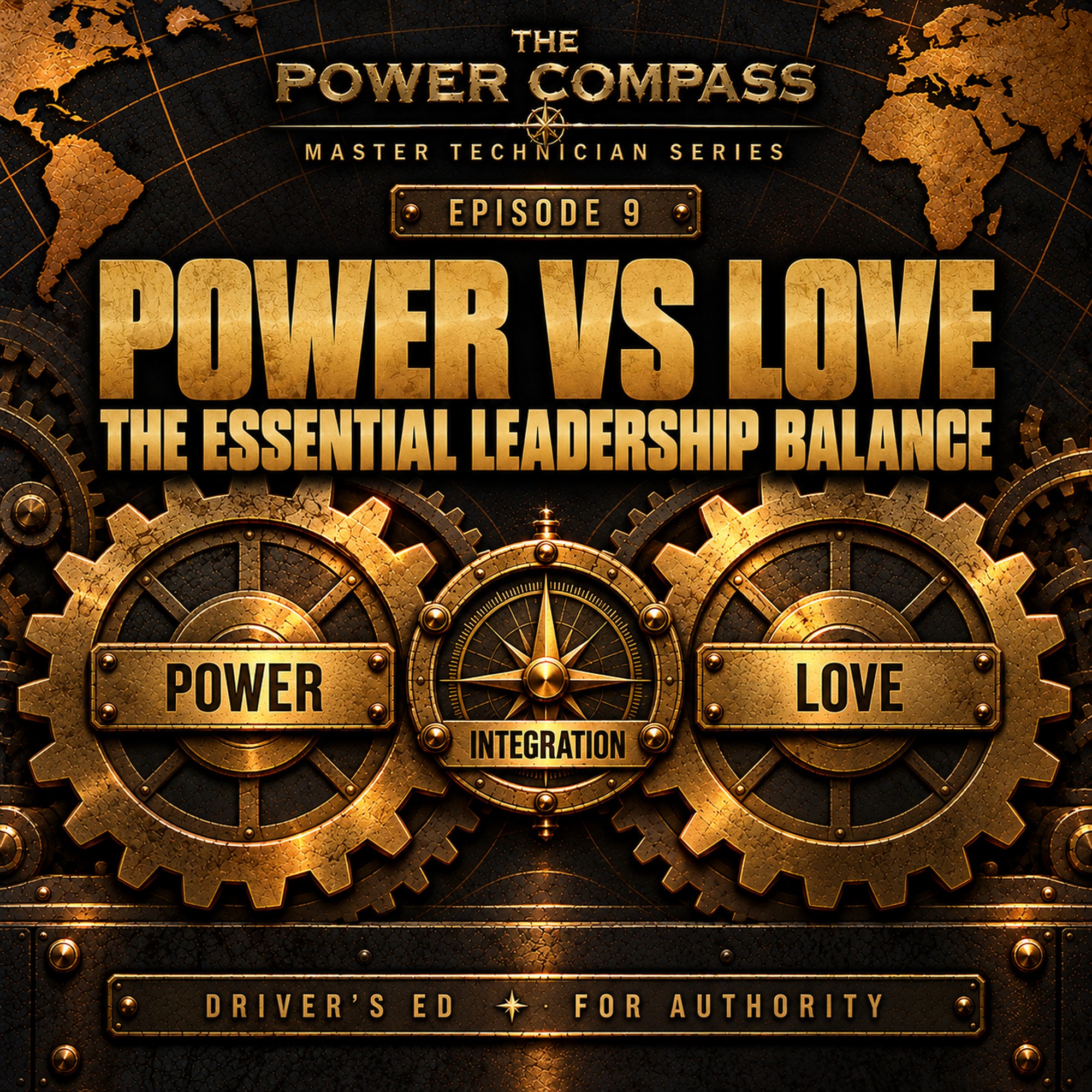
#9 Power vs Love | The Essential Leadership Balance
The Story
Why do leaders get stuck on one side of a hidden divide? The power-versus-love polarity, and how to integrate both.Every leader lives inside a hidden polarity: power on one side, love on the other. Get stuck on either end, and it costs you.
WHAT WE DISCUSS Drawing on Adam Kahane's Power and Love, we explore what happens when leaders lean too far into “love” — avoiding conflict, saying yes when they mean no — versus too far into “power” — becoming controlling, perfectionistic, and driven by fear of failure. We share personal stories from our own leadership blind spots and make the case that integration, not balance, is the real goal.
In this episode: • The fundamental polarity between power (differentiation) and love (connection) • What happens when leaders get stuck on the “love” side — chaos disguised as harmony • What happens when leaders get stuck on the “power” side — perfectionism and burnout • A personal story about learning to voice needs without losing connection • The “hamburger” dynamic: compliant upward, controlling downward • Adam Kahane's insight — love makes power generative, power makes love generative • Why integration, not balance, is the real goal
RESOURCES & LINKS MENTIONED • Adam Kahane — Power and Love: A Theory and Practice of Social Change — https://bkconnection.com/products/9781605093048_power-and-love
COMING UP NEXT Next time: what power actually costs — the honest, unfiltered version nobody tells you before the promotion.
ABOUT YOUR HOSTS Dr Steve Vinay Gunther Therapist · author · organisational consultant · founder of Gestalt Therapy International. A practicing therapist since 1986, his life experience includes street theatre, clowning, community activism, and a range of businesses — including a vegetarian cafe, printing press, sign-writing business, and food coop. He founded the Northern Rivers Gestalt Institute in Australia and has been running professional therapy training in China since 2012. He has taught in many countries over the last 25 years, is director of Gestalt Therapy International, and founder of Learn Gestalt. He has practiced meditation since 1973 and was Professor of Spiritual Psychology at Ryokan College in Los Angeles. He is author of the bestseller The Woman In Your Life — A Man's Guide to a Happy Relationship, published in four languages. An accredited career counsellor since 1993, he developed a unique system called Career Decision Coaching. His PhD explored the interpersonal dynamics of power with managers across three countries.
Dr Paul Donovan Organisational consultant and trainer · executive coach · author Owner and director of The Change Company, founded in 1999. He specialises in working with senior executive teams — facilitating team building and strategy, coaching, and leadership development. That work often involves Paul assisting executives to pause their transactional and familiar conversations and examine the individual and collective tensions that are not being discussed. His research suggests these "undiscussable" topics are often among the most strategic for the organisation. Paul has worked across sectors including property development, higher education, pharmaceutical, defence, food manufacture, high-technology medical, government, consulting, and finance. He has published several research articles including a chapter in the award-winning Realising Critical HRD — Stories of Reflecting, Voicing and Enacting Critical Practice. He wrote the popular book Bosses Behaving Badly, exploring how power can be applied skilfully by those in leadership positions.
PowerVsLoveLeadership #AdamKahanePowerAndLove #TaskVsRelationshipLeadershipStyle #WhyLeadersAvoidConflict #ControllingBoss
Speaker 0: So, welcome everyone to our next podcast. Speaker 0: I'm Dr Stephen Aguntha here with Dr Paul Donovan talking about all things related to power. Speaker 0: so today we're gonna take a particular angle and were going talk about two ways of understanding human nature and how we interact with each other in the variety circumstances And these two basic polarities that we are describing or apparent polarity love and power. Speaker 0: Now, of course loves a very complex word can mean a lot things but we're using it in general sense.
Speaker 0: connectivity obviously has to do with control direction authority. Speaker 0: so that's the basic orientation our discussion today.
Speaker 0: classic quote by Martin Luther King, who says power without love is reckless and Love Without Power is sentimental an anemic. Speaker 0: Very astute observation I think. Speaker 0: And so Paul what? Speaker 0: where should we start? Speaker 1: Yes Thank you very much Vinay. Speaker 1: yes We should start on this because it's such an important topic and Because It Speaks to a really deep polarity which has been identified in literature and even leadership literature for many years. Speaker 1: And it is one that if we knew where were in, We would manage better but often don't know when are in because inside the polarity usually on one end of not noticing how drifted to what you said earlier.
Speaker 1: way considering power here is this drive to achieve, this drive for growth. Speaker 1: To have an impact...to realize oneself as more in the world and experience one's differentiation from others. Speaker 1: As you do that You step out of your pack And make something happen. Speaker 1: That's powerful That's power. Speaker 1: And so that is power on one hand and yet, the other challenge. Speaker 1: we have another part of ourselves which can be described as love where looking to make connection We want to feel ourselves in relationship.
Speaker 1: We don't wanna feel separate, we wanna feel united combined and that's how the... That's our using of word love. Speaker 1: And there is just this extraordinary polarity that were are in. Speaker 1: To the extent where can manage coherently and intelligently this polarity will be to the extent that we won't get lost on one end than the other because there is real danger in getting caught at one end, not knowing you are. Speaker 1: That's a big issue. Speaker 1: In fact most leadership tools acknowledge this polarities.
Speaker 1: The leadership tool I know when both of us use Vinay describes the polarity between task and relationship, which as its essence has the same fundamental polarity in it. Speaker 1: The drive to achieve results...to be strategic..to make decisions....and move on! Speaker 1: And the drive for teamwork, collaboration, emotional intelligence team play and a feeling of safety with each other. Speaker 1: And there are big challenges if we get lost in one end without holding the other, Speaker 0: yeah?
Speaker 0: Yes great introduction I pick up on number words. Speaker 0: you use the polarity, and indeed these appear to be polarities. Speaker 0: And yet they're both important dimensions. Speaker 0: if you just end up at one end or the other there's definitely going to be problems... ...and also pick-up your term of drive for growth because in a way ultimately what we are on about is not using power effectively although we're very interested in that. Speaker 0: We are ultimately interested in people's growth and the ways in which power is a part of your, you'll grow whether it be the growth in your career or The growth in life for as a parent You know apart of your growth and development And indeed That often does require differentiation.
Speaker 0: That's what would use a lot particularly let say working with couples and both are necessary. Speaker 0: You need to have that sense of unity in closeness, connectedness. Speaker 0: then you also need be able to make your own self decisions not be afraid or compromise yourself in your anticipation of what other people think or need. Speaker 0: In another words, be powerful in you own right. Speaker 0: so yeah these are fairly universal dynamics and I know that we mentioned the word team a number times.
Speaker 0: certainly teamwork is good example of importance. Speaker 0: relationship Speaker 1: Yeah And for myself just hearing say it's refreshing. Speaker 1: my tendency has been toward relationships.
Speaker 1: know that for instance, you know I'm in my second marriage. Speaker 1: I've been married though for a long time have been with my partner of like twenty five years or more. Speaker 1: but In my first marriage and to a lesser degree in my Second i Have struggled With the The courage To voice what? Speaker 1: I need now And What I want to create Now Because that can feel very risky and vulnerable when one's located more down on the relationship. Speaker 1: And because it could disrupt relationships, but they create problems I might rupture their connections to help me feel safe in this world as i've grown older To voice what it is I want to create, What's true for me?
Speaker 1: What my needs are. Speaker 1: And only to discover that the connections between myself and my wife have grown stronger not weaker But its a death defying thing in this journey because It feels like a mini-death. Speaker 1: You could be about to lose everything thats important to you by simply voicing whats authentically True. Speaker 1: even So I've been at work on those issues and because i just know that my tendency is a bit more towards relationships, so working with the fears around voicing other side.
Speaker 1: And I realize maybe we worked this end first you know? Speaker 1: The danger of love without power.
Speaker 1: I've experienced that, you know? Speaker 1: You can have what looks like the illusion of a peaceful relationship but it's really not. Speaker 1: You said yes when you mean no!
Speaker 1: Yes to bosses only define yourself in a world of pain so the illusion is very costly as counterfeit wholeness. Speaker 1: That of that we end up experiencing by getting lost in the love side and ultimately feelings You get stifled and held in by claustrophobic relationship where you can't break free And do what? Speaker 1: You need or you may find yourself overly loyal to your organization into your boss only To actually bypass The growth and the journey that you've been invited to do in this lifetime.
Speaker 1: I don't know about you, that's me. Speaker 1: My thing on getting lost a little bit and avoiding not occupying the power of differentiation Speaker 0: Yeah, very interesting. Speaker 0: I mean what Speaker 1: about you talk? Speaker 0: About this side? Speaker 0: actually think about it. Speaker 0: We just I just rewatched the movie once were warriors that amazing Maori movie Yes twenty years ago because my wife's Chinese and she hadn't seen it as if there is an intense movie for those of You haven't seen at its documentation Of a certain elements of kind of What's happened to Maori culture in modern days both traditional on the loss of that.
Speaker 0: One of the things that's very interesting in that movie is the portrayal violence. Speaker 0: Jake, husband and father are a very powerful man. Speaker 0: you just look at him. Speaker 0: he just exudes power. Speaker 0: it's impressive. Speaker 0: as a man I'm like whoa! Speaker 0: That's pretty incredible. Speaker 0: At same time although he has some love not just cardboard cut out character at the same time. Speaker 0: He can also be very violent when he feels threatened, including towards his wife and there's some terrible scenes about that.
Speaker 0: so I guess what i'm thinking about is yeah the dichotomy unfortunately which often exists now. Speaker 0: myself perhaps a bit like you. Speaker 0: I identify as feminist, i don't want to be patriarchal male who commands women or carries forward those centuries millenia attitudes towards women and i want to have mutual consensual relationships with women. Speaker 0: the issue is how do that yet retain my power? Speaker 0: probably err on the side of the consensial at cost when saw this movie.
Speaker 0: that guy has some power, and it's a bit fascinating with just the aura of power here. Speaker 0: So yeah we can you know... We're starting with the mistake of being too relational which hardly seems like could be a mistake. Speaker 0: how? Speaker 0: How can being relationally considerate been a mistake? Speaker 0: but as you point out when you start compromising.. When you start not saying things ,when you start maintaining peace for the sake of kind of harmony harmonization As they say in China Yeah then It becomes problematic.
Speaker 1: Yes, it really does because there are certain strengths in being relational. Speaker 1: but to the extent that we're using those strengths to guard against fears then we get into deep water. Speaker 1: That's when you start getting problems. Speaker 1: and so the strength of relationship is cool And its great be able read people well and take a temperature on room. Speaker 1: those, you know to have long radar. Speaker 1: To be able to sense what's going on psychologically or emotionally in a room.
Speaker 1: that's all very helpful except if it is being used. Speaker 1: just try and keep me safe in the world because I'm scared Or because i've got fears that are never really examined And thats where its actually not helpful. Speaker 1: So fear Is The Fundamental Undoer Of That Love. Speaker 1: it's the fundamental undoer because if I, to the extent that i bring fear and anxiety in. Speaker 1: I use all my relational talents and skills basically to try and keep me safe and alleviate myself from my fears so...I keep people smiling around me!
Speaker 1: I keep people liking Speaker 1: me!! Speaker 1: I keep pleasing people because they don't Speaker 0: know. Speaker 1: Yeah, and if I don't do that then i'm done for. Speaker 1: Then I am lost And there's the work of a person who is more likely to find themselves up on their love side. Speaker 1: The relationship side Is addressing fears associated with potential rejection And that alone, you mean none of those things could hurt. Speaker 1: I think they could all be very helpful But it's a journey.
Speaker 1: That's taken over years in my experience to slowly migrate out Of an orientation towards self-protectiveness Out of fears and using my orientation toward relationship To subtly control others in such a way as they still like me. Speaker 1: please me approve of me want to be with want to protect me, all the things that those with relationship orientation can get involved in. Speaker 1: And there's the territory
Speaker 0: I would say, because we started talking about growth and want to support people's growth in all the dimensions of their life. Speaker 0: The issue here is that there are too much love or relationship in this sense – stifles growth! Speaker 0: And if you take leadership as a leader who is unwilling to set boundaries or hold people accountable—in other words use your power sufficiently —they're too anxious for maintaining connection with relationships then indeed that stunts their own growth, it stunts the growth of team and can also ally them with sort oppressive systems which they're not doing something about or ineffective system.
Speaker 0: Yes Speaker 1: beautifully said! Speaker 1: That's exactly my experience. Speaker 1: those managers who have a leaning towards relationship side Create ultimately teams that look okay from the outside, but they're relatively chaotic on the inside Because that manager will not Hold people accountable. Speaker 1: We'll knock you clear message around. Speaker 1: underperformance won't step in to resolve conflict Won't raise tough issues or problem or subjects that they think could be disruptive Or create tension.
Speaker 1: They're the requirements of a team leader. Speaker 1: Team leader to fulfill their role as team leaders must do those things, but for us who have a leaning toward relationship and are still shrouding that leaning in fear will not do these things required. Speaker 1: That's right. Speaker 1: So maybe we should go to the other end? Speaker 1: Yes, Speaker 0: The more familiar and in some ways I guess certainly In terms of when you talk about power that's what people think About is the degenerative aspects at power And the way it can be used in heavy-handed sense.
Speaker 0: and obviously thats just as much an issue and Certainly very obvious. Speaker 1: Yeah It really Is! Speaker 1: This where well in a corporate environment You have someone who overly driven and especially like hold people to impossible standards be perfectionistic. Speaker 1: So, overly-driven perfectionistic controlling of their role to an extent that is beyond what is useful so they become micro managing bureaucratic being terribly Concerned about small details because to do so feels risky.
Speaker 1: So you've got here, You've got someone who ultimately drives others relentlessly holds them two impossible standards and it end. Speaker 1: And he's prepared. Speaker 1: and so is overly controlling of the tasks that they're involved in. Speaker 1: bosses and managers who are into power tend to find themselves dominated in their world by what task has to be done. Speaker 1: And they're, in fact... Their fundamental fear is around failing! Speaker 1: And the fear of failing if not examined or transcended makes this drive for power so controlling and claustrophobic.
Speaker 1: And it's, I've worked for bosses like this. Speaker 1: It's exhausting and as the follower of such a boss when i was younger person its hard not to feel increasingly resentful Like you can't keep up with that person who is working so hard on moving fast So he could never do enough.
Speaker 1: it's a difficult dilemma. Speaker 1: I don't know about you, have you ever worked for bosses too far on the power side? Speaker 0: I have to admit that i haven't worked with so many people mostly operated as an independent operator in my life run my own businesses and things but few occasions where I've contracted to people or something yeah...I become a cropper because directions, which I don't think are reasonable or appropriate. Speaker 0: I question things and it doesn't go down well with bosses who were not used to that.
Speaker 0: so you know this is basically in my more mature years where this has been the case and so i haven't really being subject perhaps more as a young person Speaker 1: to the power Speaker 0: influence of such a person. Speaker 0: I can stand up to such people now at my cost sometimes, but i certainly can and am willing to do that. Speaker 0: whereas yeah when you're younger and don't feel so much personal power um...and your-you are in learning mode or admiring looking up too it's much harder for fewer powers to deal with someone who is overpowering.
Speaker 1: Yeah, yes it is. Speaker 1: I can remember bosses as a younger person who are in this category and i can see now in retrospect how terribly anxious they were but didn't really see their anxiety at the time just felt the strength of that push which was tough. Speaker 1: you know In some cases, it can even lead to a kind of an unethical approach... ...to the demands that people are working for them. Speaker 1: To do things which were well beyond time spent and requirements... ...well beyond what might be reasonably expected of people Speaker 0: I see here in China.
Speaker 0: It's part of their culture The nine-nine six so to speak. Speaker 0: I mean, here bosses will have no compunction about texting someone at midnight and asking them to do something. Speaker 0: And people respond... People look at their phone. Speaker 0: you know they scrabble what the arse. Speaker 0: there's very few sets of boundaries which is kind a little frightening because then there are no restraints on that power. Speaker 0: if somebody just wants things done or people are fodder than basically go for it And people are afraid not to respond.
Speaker 1: People who're afraid, not to responded absolutely and you can have someone in my experience has a tendency towards the power side, task or differentiation. Speaker 1: but when they dealing with very powerful orientated boss then soon become quite compliant. Speaker 1: so sometimes we call this sort of hamburger of organizational life, because you look up and your being relatively compliant to a boss whose demands are enormous. Speaker 1: And you may be very reasonably worried about not fulfilling.
Speaker 1: so go the extra mile or do an extra thing. Speaker 1: You say yes when really mean no. Speaker 1: But then that same person Turns below them and they become the same Unrelenting boss, and the person underneath him looks up and becomes controlling but then looks down to them. Speaker 1: it becomes very Task-orientated. Speaker 1: so you got this flip flop flip flop. Speaker 1: This hamburger kind of idea. Speaker 1: And Because But in either way whatever It is its a Very unhelpful Inhumane And frankly, unproductive way to run a business.
Speaker 1: It can get you short term results and of course... You could imagine China has been running on this for some time but also China let's face it is in an broader environment or broader authoritarian environment so that kind of approach more accepted? Speaker 1: Yeah I Speaker 0: mean historically The authoritarian thing here is complex because actually people have a lot of freedom on the ground and it's kind of bit wild west in some ways. Speaker 0: so Speaker 1: It's Speaker 0: not straightforward authoritarian regime or other way societies run.
Speaker 0: And what interesting as I mean my research my PhD research was interviewing middle managers in exactly the position that you're talking about and In terms of their experience using power. Speaker 0: And I have to say that the Chinese subjects were definitely The most interesting ones because they had experienced both like often working multinational contexts, which are flatter organizations and such. Speaker 0: Also chinese organizations Which tend to be more vertical?
Speaker 0: Yeah, I mean there's too many comments to go into here. Speaker 0: What is interesting to me though Is that the people That i interviewed small sample, but nevertheless they all consistently said yeah you can get short-term results by forcing people to do what You want them to do? Speaker 0: But in the long term it doesn't work. Speaker 0: and then you have to Have relationships. Speaker 0: You have to get them on board which is an interesting integration of What we're talking about. Speaker 0: I mean We were talking About The two extremes that obviously what's best Is To bring both of Them together And for whatever reasons.
Speaker 0: the Sample That interviewed found that, as middle managers. Speaker 0: That was the only way they could really in the long run and these were people with at least five years experience often for twenty-years. Speaker 0: so it's Speaker 1: just a fantastic segue because its probably time to talk about their integration. Speaker 1: isn't this just? Speaker 1: the challenge of us growing is to integrate polarities. Speaker 1: That's at the essence of it, and I can't think any polarity more powerful than that between power & love.
Speaker 1: Adam Cahane in his book Power & Love said love makes power generative instead of degenerative And power makes LOVE generative Instead of degenerate. Speaker 1: The two together make each other better and pulling one out leaves makes leaves, if there's insufficient of one it leaves the other degenerative.
Speaker 1: Not effective not human and so our task is to increasingly integrate these two parts Knowing that when we do so, We're actually above both parts the more. Speaker 1: We can identify The part for differentiation For drive of power and the drive for connection for affiliation for relationship And if were able to create. Speaker 1: I was just working with a client this morning about This very thing inviting her To become meta noticing these two parts And interestingly, and what the most critical part here is in terms of integration.
Speaker 1: Is building better relationship between these two parts allows us to more comfortably draw on them when we need them? Speaker 1: The context will let us know. Speaker 1: do I need to be powerful or clear about where were going with the results that needed decisions for making a task?
Speaker 1: pause, connect build rapport listen establish a kind of playful team context collaborate take moment. Speaker 1: to connect and build relationship such at different contexts in different moments will need more one than the other. Speaker 1: And our ability to build easy relationships between these two is secret because if they don't have good relationship then you tend to get one playing around in this playground inside of us and the other's hiding, where we want be able have both an easy relationship that can draw on either when time is right or context demands.
Speaker 0: Yeah I think if there are two Gersholt writers backmen who wrote intimate skills instrumental skills or something like that. Speaker 0: And basically what they're talking about, because when you talk about this You really describing two sets of skills both which are necessary in different situations and I think Describing them as skills makes them kind of a bit more learnable, it makes them into behaviors. Speaker 0: It's something that we might instruct people in or coach people because really both those skills are necessary.
Speaker 0: you need intimate skills to be able connect with relationships and being empathic.
Speaker 0: Those are essential skills. Speaker 0: if any leader doesn't have the skills they're just not. Speaker 0: they're going to lean on their power. Speaker 0: On the other hand, there are skills of leadership using power and making hard decisions firing people. Speaker 0: you know as my own entrepreneur I at various points employed a few businesses ran a gelato vegetarian cafe in Lismore for a number of years, and I had to learn very quickly that i had to fire people very fast. Speaker 0: You know like...I just have learned wow!
Speaker 0: Mr nice guy has to go. Speaker 0: someone doesn't fit. Speaker 0: they haven't got the right attitude They're not trainable. Speaker 0: I've gotta get rid of them because otherwise there's drag everything down absorb enormous amount my time. Speaker 0: so yeah..i really need to step into some power skills.
Speaker 1: That's great. Speaker 1: You know, and that reminds me it wasn't just me but I've now worked with so many CEOs over the years And i can't recall which author said this. Speaker 1: But number one regret for CEO is they stayed with wrong people in their team too long. Speaker 1: Isn't that interesting? Speaker 1: Yeah, they just you know didn't want to get rid of them. Speaker 1: Why? Speaker 1: They were a little bit too much on the love side and a little...too little in the power side.
Speaker 1: How interesting! Speaker 1: That's Speaker 0: fascinating regret Speaker 1: yeah. Speaker 1: It is a fascinating regret. Speaker 1: I'd let wrong people stay for too long on team.
Speaker 1: And here in Australia i see that as one. Speaker 1: widespread challenges is the tendency for managers not to be clear about their expectations and whether someone's performance is meeting them or not. Speaker 1: I am all-the time coaching managers to step more into the power side.
Speaker 1: Yeah, it's a commonplace piece to be more clear...I was working with a CEO last week And she was discussing what that challenge he has with her board. Speaker 1: And one of the things that she noticed, she was doing... She's a great CEO. Speaker 1: Doing a wonderful job! Speaker 1: One thing she noticed in our coaching is when she had to present a new way forward for her board and she sensed that the Board weren't exactly sure, She would then just provide more options. Speaker 1: And she'd veer away from this is-the-way I'm recommending which should go.
Speaker 1: am i getting yes or no? Speaker 1: So our work is to encourage support her step into power side with her board rather than shy away from that side where she's looking to just continue to build relationship with them. Speaker 1: And so it operates at any level you like. Speaker 1: and yeah, interesting! Speaker 0: Yeah I mean thats on that side. Speaker 0: stepping into the power side i think we could say stepping in to the relational is clearly important as well where that's missing. Speaker 0: because one of the consequences of this sort extreme leaning into power, you also get a kind of polarization and us or them black-and-white thinking which obviously unproductive, and it's also in a sense we could say what is happening on our contemporary world.
Speaker 0: You know the US? Speaker 0: The Republicans or Democrats who previously would always... Vi for party seats or whatever, but it used to be kind of something a little more cooperative was now. Speaker 0: It's just so extreme and that is the effect of this kind of extreme use of power we're seeing. Speaker 0: So yes its very destructive both ways when you don't have that. Speaker 0: And thats also another reason why going down the heavy power end is without love, it's definitely destructive in organisations and society.
Speaker 1: Yes yes most definitely. Speaker 1: its not just a pain in the arse to work with but highly destructive. Speaker 1: ultimately leads to lack of wise decisions.
Speaker 1: I think there are some who would suggest that many of the most problematic decisions made by organisations is when decision-making was made by one very powerful person or one, two very powerful people. Speaker 1: and it's not seasoned. Speaker 1: It wasn't rounded from input relationships at that executive level. Speaker 1: It was so much power invested in the hands of one or two who insisted on holding that power, that decision-making power and running with it out a fear of having their own impetus for action.
Speaker 1: And they're own design on the world altered Or not executed and That's Doing a grave miss service to their own organizations into the wider world. Speaker 0: Yeah, so I guess just to move towards wrapping it up. Speaker 0: We're talking about awareness and we can provide a challenge to our audience To think about this. Speaker 0: You know what? Speaker 0: What is your tendency? Speaker 0: do you tend towards leaning toward some sort of reckless power over differentiated? Speaker 0: i make the decisions Ord.
Speaker 0: you moved too to put another pathological term we could say is anemic love, the conflict averse type of orientation. Speaker 0: So if you who are watching this want to consider yourself and observe your self-track yourself look at this week's impact in terms whether or not they need more power to their heart.
Speaker 1: Amen! Speaker 1: That would be great for those listening Can bring their own level of reflection and begin to think about how to bring both more More wholly And to be able to naturally draw on these two energies at different times To integrate the both. Speaker 1: Yes, Speaker 0: that's why I'm all for this Wonderful okay? Speaker 0: That's a wrap and we'll see you next time. Speaker 1: Thanks very much. Speaker 1: See ya next time bye.
 Apple Podcasts
 Castbox
 Castro
 Goodpods
 Moon FM
 Overcast
 Pocket Casts
 Podbean
 Podcast Addict
 Podcast Republic
 Spotify