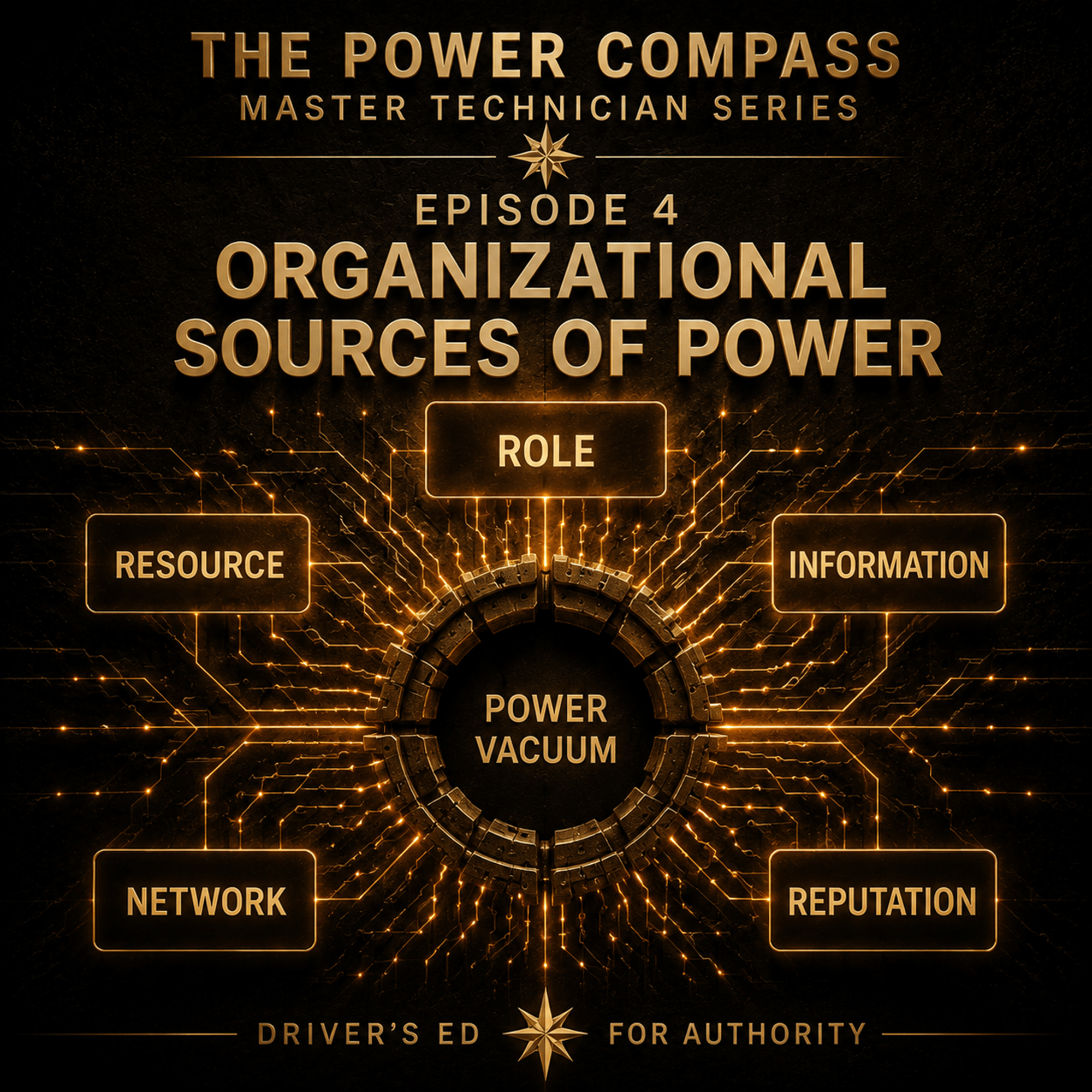
#4 The Real Sources of Power Hiding Inside Every Organization
The Story
Where power comes from at the organizational level, and what happens when people underuse or misuse it?Underusing your authority can be just as damaging as abusing it. Here's why leaving a power vacuum is its own kind of failure.
WHAT WE DISCUSS This episode maps five organizational sources of power — role, resource, information, network, and reputation — and the very different ways each one can be misused, from heavy-handedness to simple avoidance. We use real cases, including a 25,000-person walkout, to show what happens when authority goes unacknowledged, and why “nice” leadership can quietly create as much damage as controlling leadership.
In this episode: • Five organizational sources of power: role, resource, information, network, reputation • Why underusing your role power creates a dangerous vacuum • Resource power: budgets, access, and the choices we forget we have • Information power and the psychology of gossip • Network power and the story of a 25,000-person walkout • Reputation power and the rise of cancel culture • Why role power without acknowledgment breeds resentment
RESOURCES & LINKS MENTIONED • Robin Skynner & John Cleese — Families and How to Survive Them — https://www.goodreads.com/book/show/20582.Families_and_How_To_Survive_Them • Robert W. Fuller — Somebodies and Nobodies: Overcoming the Abuse of Rank — https://www.amazon.com/Somebodies-Nobodies-Overcoming-Abuse-Rank/dp/086571486X
COMING UP NEXT Next time: the three inner domains of personal power — capable, aware, and purposeful — and what they reveal about who's actually ready to lead.
ABOUT YOUR HOSTS Dr Steve Vinay Gunther Therapist · author · organisational consultant · founder of Gestalt Therapy International. A practicing therapist since 1986, his life experience includes street theatre, clowning, community activism, and a range of businesses — including a vegetarian cafe, printing press, sign-writing business, and food coop. He founded the Northern Rivers Gestalt Institute in Australia and has been running professional therapy training in China since 2012. He has taught in many countries over the last 25 years, is director of Gestalt Therapy International, and founder of Learn Gestalt. He has practiced meditation since 1973 and was Professor of Spiritual Psychology at Ryokan College in Los Angeles. He is author of the bestseller The Woman In Your Life — A Man's Guide to a Happy Relationship, published in four languages. An accredited career counsellor since 1993, he developed a unique system called Career Decision Coaching. His PhD explored the interpersonal dynamics of power with managers across three countries.
Dr Paul Donovan Organisational consultant and trainer · executive coach · author Owner and director of The Change Company, founded in 1999. He specialises in working with senior executive teams — facilitating team building and strategy, coaching, and leadership development. That work often involves Paul assisting executives to pause their transactional and familiar conversations and examine the individual and collective tensions that are not being discussed. His research suggests these "undiscussable" topics are often among the most strategic for the organisation. Paul has worked across sectors including property development, higher education, pharmaceutical, defence, food manufacture, high-technology medical, government, consulting, and finance. He has published several research articles including a chapter in the award-winning Realising Critical HRD — Stories of Reflecting, Voicing and Enacting Critical Practice. He wrote the popular book Bosses Behaving Badly, exploring how power can be applied skilfully by those in leadership positions.
SourcesOfPowerInOrganizations #RolePowerVsResourcePower #WhyManagersUnderuseAuthority #TypesOfPowerAtWork #PowerVacuumLeadership
Speaker 1: So, welcome everybody to the next episode of our podcast. Speaker 1: Dr Vinay Guntha here and Dr Paul Donovan discussing power. Speaker 1: We've been talking a bit about personal power And there's more to talk about it. Speaker 1: today though we want to focus on some elements of organizational Power and we're going to talk About five specific Elements and I'm just gonna run through them right now as titles. Speaker 1: so The first one is role-power. Speaker 1: So these are in the context of it could be an organization, but if they could be Situations where enrolls like parents or something so keep them in mind for both this.
Speaker 1: The first one is role power Which as I say exists a variety of areas? Speaker 1: The second one is resource power. Speaker 1: The third one is information power which was very relevant to him Dave, of information being so abundant. Speaker 1: The fourth one is network power or collective power. Speaker 1: and the fifth one is reputation power. Speaker 1: So let's dive right into role-power. Speaker 1: What would you like to say? Speaker 1: To introduce this Paul Speaker 0: Thank You Vinay.
Speaker 0: Right Now This Is An Essential First authority that comes to us when we're in any kind of structure or organization. Speaker 0: And as you said, Vinay... That can include a family system. Speaker 0: so the role of a parent has an inherent authority or power invested in it and also the role. Speaker 0: someone who manages others for instance have certain authority or power invested in that role, in relation to those people who are reporting to them. Speaker 0: So this is a very legitimate source of power because within that role it's embedded the authority to do things—the freedom to take action and make decisions —that those who might not be able to inhabit your role can't!
Speaker 0: So for instance, in a classic organization. Speaker 0: A managerial role has the power to potentially distribute work across the people that report them To give performance reviews...to clarify rewards even salary increases or decreases.
Speaker 0: It's it's a roll that has far-reaching Power and In this podcast, we're going to suggest that it's very good to acknowledge the authority that your role has. Speaker 0: And the more you are able to acknowledge It The More You Are Able To Use It Consciously and Effectively And Not Unconsciously Become Clumsy With It Because When We Don't Acknowledge The Certain Authority and Power That The Roles We Enhabit Have But Thats when We Start Misuse It. Speaker 0: And so that's what I. yeah, do you want to say something about that Vinay?
Speaker 1: Yeah. Speaker 1: Well there's lots of interesting things to say. Speaker 1: the first is as we've discussed before There's a problem not only with the way that people use power But the way people don't use power. Speaker 1: So when someone has a role they have duties assigned to them. Speaker 1: They have power given to them over others. Speaker 1: Then if they don't fully use that power it can create a kind of power vacuum and That creates as many problems. Speaker 1: in some ways, there's people who overuse power.
Speaker 1: So we've got two ends of the spectrum. Speaker 1: in a sense We have the over-use or heavy handed use and unskillful use And under-use is just as much concern. Speaker 1: Now you probably get lots of illustrations on an organisational level Certainly in terms of parenting which was mentioned Which has common role that most people do. Speaker 1: There's a problem both ways, too. Speaker 1: You can get authoritarian parents who are over-controlling and overstricted don't allow the kids much space for creativity or movement or autonomy.
Speaker 1: On the other hand you also get parents that kind of very hands off And they don't want to tell their children what to do. Speaker 1: so called permissive parents Although this looks like it is enabling Or giving them freedom which in true way It could create power vacuum about where parents are afraid or unwilling to come in and use their role power, to set healthy boundaries. Speaker 1: And that creates just as much problems as it does the heavy-handed authoritarian Speaker 1: parent.".
Speaker 0: Yes both are derived from a lack of awareness about.
Speaker 0: We tend to call the manager or leader who does not step in, for instance... ...to take decisions in a timely way. Speaker 0: Who may divvour around decision because they're concerned about... ...the kind of disruption that maybe people will get pushed back Or maybe there'll be conflict. Speaker 0: Maybe those fear just getting it wrong and so a leader may be apprehensive to actually take on the obligation of their role, set direction. Speaker 0: And make decisions in areas which they are tasked with making decisions but...
...in case that the compliant manager is not. Speaker 0: You Speaker 1: want me give some Speaker 0: examples? Speaker 0: Yeah sure! Speaker 0: So for instance, I was working with a manager not so long ago. Speaker 0: these examples that after so many years are easy to draw on.
Speaker 0: A manager...so for instance iIwasworkingwithsomeonewheretherewasaverydemandingclient and so this was a consulting company And it was very demanding client high-end consulting where they work in the medical and pharmaceutical arena providing consulting consulting services to pharmaceutical and other kinds of organizations, sometimes those clients can become very demanding. Speaker 0: And they want more and more. Speaker 0: and it should be said consultants for this reason could sometimes get treated poorly because there in a lesser ranked role than the customer who was really elevated.
Speaker 0: But it needs the decision sometimes of a manager to the consultants, to decide hey are we really stretching too much for this client? Speaker 0: Are we trying to give too much to them. Speaker 0: Are we busting our gut here to meet unhealthy and unreasonable time demands? Speaker 0: see The consultant will just follow the lead of the manager. Speaker 0: And if the manager will say, this is an important client you must do this let's work at it I'll help or of our team is seriously at risk here.
Speaker 0: And I can also see that we might just find ourselves in a position of over-promising and under delivering, i'd like to now have a conversation with the boundaries that we may like to put in place in relation to this client. Speaker 0: Now thats an important conversation! Speaker 0: It's great for a manager or consultant but where they are afraid internal consultant or afraid of upsetting the client, they may back off and just let things play out. Speaker 0: Meanwhile seeing burnout on the case of the internal consultant burnout resentment and potentially failure in terms of delivering.
Speaker 0: you see that In this case The manager of the consultant was just. Speaker 0: You know what? Speaker 0: They're doing. Speaker 0: They were underusing their power, they weren't stepping in and giving direction and assisting a good boundary formation. Speaker 0: And what that was doing is using the freedom of their elevated role just to back off on watch. Speaker 0: I'm not getting affected by this terribly much right now even though i can see my team member here drowning This is freaking me out!
Speaker 0: and then watch this whole slow-motion car crash unfold in front of them. Speaker 0: And it happened because the manager above simply was too apprehensive to step in, and utilize their authority to create good boundaries! Speaker 0: That was there role to do that. Speaker 0: they failed to do So. Speaker 0: yeah, it's that and a hundred other examples where managers will not step in to make decisions or we'll dither or hold off. Speaker 0: In fear of upsetting somebody losing favor being loss of approval all sorts considerations like Speaker 1: Yeah, that's a great example.
Speaker 1: and certainly if I come back to parenting although you know we're talking about two classic roles. Speaker 1: And i want to point out there are lots of different other type of roles that we occupy. Speaker 1: even the role of consumer has certain kind of power in relation to service workers. Speaker 1: but just staying with parenting for a moment There is very good book came up quite few years ago by Robin Skinner Robinskinner and John Cleese, they had these conversations called Families on how to survive them.
Speaker 1: They're talking about lots of aspects the way family systems work. Speaker 1: I always remember that Robinskiner was describing if you have authoritarian parents. Speaker 1: it can restrict a person you know, damage them in some ways. Speaker 1: But they can recover. Speaker 1: however if you have a permissive parent who doesn't put boundaries and it doesn't really use their role power well You get people without the sense of their own Boundaries And They Can Become Quite Narcissistic And Quite Problematic That It's Hard To Recover From That Later In Life.
Speaker 1: So that boundaries are very important essential things that anybody in a role position does is they set boundaries and expectations. Speaker 1: You're describing one instance where someone's stepping back from. Speaker 1: I'm sure people have lots of examples where either they've witnessed that in the form of a boss or perhaps, themselves had been reluctant to step-in and fully use their role power. Speaker 1: So what we're trying to do on this podcast is advocate for power. Speaker 1: We were saying power's a good thing Power's important!
Speaker 1: We all have power in different situations. Speaker 1: The issue with awareness and skill you know, use it reactively or used for own interests primarily at the same time to embrace having power and to enjoy even aspects of stepping in that power Speaker 0: role. Speaker 0: Yeah beautifully said we are about good use of power here And To do that We must see where the Power is That's flowing through us when we occupy certain roles and you know, that's just such a critical component of good power use for NA.
Speaker 1: Now mention this word rank which I think is also relevant when we're talking about roles or certain kind formality in terms who has the power and doesn't Rank as an interesting word because it does not always go with the obvious roles that we have? Speaker 1: and yet rank can exist in a whole variety of situations, social situations interpersonal situations. Speaker 1: And there's a lot of interest in that in terms of you know race and gender and the ranked people have. Speaker 1: sometimes it is complicated.
Speaker 1: some times they've got higher ranks in terms of one sort of identity, so to speak that you occupy and lower rank in terms another. Speaker 1: There's a very good book called Nobodies And Somebody That Explores This. Speaker 1: Now yeah but what would like say about rank? Speaker 0: I find ranked are really helpful idea... ...and bring awareness too the power that role i'm may have. Speaker 0: So some my roles. Speaker 0: Well, some of the roles we all possess might just have more rank.
Speaker 0: Now in most obvious sense a boss has ranked over that person who is reporting to them. Speaker 0: They are in a role with more rank. Speaker 0: So the idea of rank might originally come from military ideas where you get more ranks and more stripes on your shoulder. Speaker 0: It's so obvious! Speaker 0: And it makes really plain Okay here I'm dealing someone with more Rank.
Speaker 0: I can count the number of stripes on their shoulder, and that means we adjust how we talk to them. Speaker 0: We tend to be more watching off their responses – we calibrate ourselves more carefully…we're more careful to watch mood and navigate around it. Speaker 0: This is what when you are dealing with a colonel compared.
Speaker 0: But in actual fact, the notion of rank applies very well to many other circumstances. Speaker 0: And as I've mentioned organizationally it can and we know that within organizations individuals behave differently in meetings. Speaker 0: when they're working with someone or talking with someone who is a significantly higher ranked than they have their behavior changes That your behavior is changing and it can help you to notice how your behaviors changing. Speaker 0: if You Can become If you can if you like put a lens over Your mind here over your eyes To see who?
Speaker 0: Is that I have rank-over, and Who is It that has ranked Over me so that i can manage that Rank difference Consciously And So That can be easy to forget when we get really upset or frustrated. Speaker 0: Sometimes bosses who might have high rank in their roles, maybe they're a director and there's people below but that may get very upset. Speaker 0: So here is the dilemma. Speaker 0: They are in role with lots of ranks so more power flowing through into them but they don't feel very powerful, maybe they feel upset frustrated exasperated and then start behaving as if there've got no power.
Speaker 0: They start barking orders out and yelling at people. Speaker 0: And that's the great challenge That can come when you're in roles that have lots of rank But actually have a low sense of power and Then start behaving in ways which aren't very useful.
Speaker 0: that poor behavior gets magnified because we expect more of the people who are above us in higher rank. Speaker 0: We demand it, in fact quite unfairly. Speaker 0: they're often better than us and so they can't afford to lose their temper when there's a high up... ...because this sends everyone into a spin! Speaker 0: And it does infact.... The lens-of power is such that if you get higher ranked then temper, for instance. Speaker 0: It's magnified many times. Speaker 0: the person who is losing their temper might feel better two minutes later than anger.
Speaker 0: well anyway let's move on. Speaker 0: and everyone else has just what happened. Speaker 0: yeah that kind of shattered. Speaker 0: now they're really watching carefully to see What did we do? Speaker 0: The trigger that We've got a. make sure we don't Do that again because it's disturbing To be around people with Really high rank when They lose Their temper. Speaker 0: And Speaker 1: another example. Speaker 1: Yeah, another example of that is a kind of common example of service workers because we do have role as the customer.
Speaker 1: That has some power in it and also has rank. Speaker 1: Easily occurs and I myself am guilty of this sometimes is that when i'm Frustrated with you know a customer service person, then i'm talking to You. Speaker 1: I can get irritated at them And kind of the tone in my voice Is not so good? Speaker 1: Sometimes my kids point This out to me confront Me With it and now i realize That i'm doing that. Speaker 1: So that's A common everyday role In which we do have some power and so It's Not just people who you Know Have high positions Of Power but But We all encounter this.
Speaker 0: Yes, that's it. Speaker 0: We'd like to build you and I together in this podcast more understanding about how power is at work... Speaker 1: ...in Speaker 0: many of our conversations and interactions with others And that It's quite probable that in those conversations one person Is exercising more power than the other because they have a role which is more rankful. Speaker 0: It's just that sometimes you use that word, rankful. Speaker 0: But I don't know if it is actually really a word but when i imagine the role has more rank than lift my hand in my head.
Speaker 0: its got more authority and higher And the higher I lift my hands The more power can flow through And that's independent of our emotions. Speaker 0: This is just a fact, we might feel powerless but in actual fact there's lot power in the role where inhabiting and it's very useful to be aware of that. Speaker 0: The customer service example was great idea. Speaker 0: were can forget how much rank when you walk into the jewellery store.
Speaker 1: Yeah, and I remember you giving me another example of the manager who sort of raised things at the end of the week as an example Of The way that they kind of unconsciously use their role power. Speaker 0: Oh yeah Thank You Vinay. Speaker 0: Yes, I was coaching someone not so long ago Who is dealing with a difficult boss? Speaker 0: And They noticed the boss had this particular kind of pattern Vinay. Speaker 0: So the Boss would come to them four-four thirty on a Friday afternoon. Speaker 0: And although we're pretty hard workers here in Australia, four-thirty Friday afternoon is getting pretty close to what we call knockoff time and that's probably an Aussie term.
Speaker 0: Venei I know you know what i mean when i say that but nevertheless the boss used to come do him and say it happened under number of occasions where he'd approach my client.
Speaker 0: Hey, I've got this particular thing going on. Speaker 0: I've Got this report that i've got a hand in very early You know to my boss. Speaker 0: do you think he could have A little look at it and just pass your eye over This? Speaker 0: because i've Got a feeling He might be able To help me out And some of the numbers In there are not so sure about. Speaker 0: Do. Speaker 0: i'd really love It if you can give Me Some feedback On That. Speaker 0: you Know would that Be all right? Speaker 0: See what's Happening here in A is you've got A Boss Who'S wanting to sound as if they're almost at the same kind of rank.
Speaker 0: We're buddies here, we are mates as we say in Australia where mate hey one mate to another do you reckon? Speaker 0: You could just have a look at this so that using language That is like I make tourmate or somewhat it's an attitude but in actual fact It's not happening that way. Speaker 0: The put my clients very aware of their lesser ranked and what really being said Here Is NOT is the part that's not discussed which is the underlying message, if you're like the managers not saying by the way remember I'm your boss.
Speaker 0: it's not a good thing just to dismiss this request. Speaker 0: You really have an obligation to do and not to whinge about or put off. Speaker 0: don't dismiss... Like both of us know that something has happened. Speaker 0: so we are asking our bosses So you have very little ability here just to shrug me off. Speaker 0: And so that's what not being said, this my client's boss is sort of utilizing roll power but without acknowledging they are and it's that what irritates us. Speaker 0: We generally don't mind if a boss says I'm going to use my authority here to make a decision, It's my job to do so.
Speaker 0: Here i go Even If we Don't like the Decision. Speaker 0: That' s actually something most of us can live with. Speaker 0: What we find really irritating Is bosses who who are utilizing their role power, but without acknowledging they're doing it in a clumsy abrasive manner. Speaker 0: And that's not okay! Speaker 0: So my work with the client was how to actually address that with the boss. Speaker 0: yeah Speaker 1: and I think there could be cultural component of this as well because both from Australia kind of a matey, matey way of talking to other people and there's the dislike of too much formality.
Speaker 1: And there is a desire not be seen as being kinda too high-the-tall poppy syndrome. Speaker 1: so I think that this also has its cultural component whereas in place like China where i live um... People are more comfortable with owning their role on their authority. Speaker 1: saying things like your feelings are not my problem. Speaker 1: You know, very crisp and clear definition of you know My role in Your Role And the ownership of rank which makes Things more straightforward In a way here.
Speaker 1: so I think this is an important thing for people to be aware Of both on The down end of power when A boss Is acting Like This and you Know it and finding some Way To Be Clear. Speaker 1: okay You know, well that's a question I guess. Speaker 1: We can talk about the boss and when you're in a role of power and the importance of owning that... ...and not acting as if there is too much friendship or horizontal relationship but remembering the vertical component which i'm going to say one way for power could be abused.
Speaker 1: Power isn't just abuse by heavy handed pushing, ramming things through and forcing people to do things. Speaker 1: Power is also abused by not acknowledging power differences And we've seen a lot of that in the whole Me Too movement The lack of awareness celebrities have about their rank In ways they use their power To get sexual favours or whatever. Speaker 1: That's because these are consenting adults. Speaker 1: I'm just talking with someone who can make up her own mind. Speaker 1: hand sounds reasonable, on the other hand completely ignores this power differential.
Speaker 1: So smoothing over power differentials can be very destructive both ways. Speaker 0: Yeah well said it is The Power Differential that just becomes invisible to the person who's applying pressure like That you know To another person You Know for sexual favours when they're in a Very high-ranking role and This Is true often Like if If you have A very much Older In my case, I'm an older guy in mid-sixties. Speaker 0: And...I've seen guys really look to bring the authority of their age and rank to younger women Without acknowledging, there is a rank difference here.
Speaker 0: There's power differential. Speaker 0: in being so much more comfortable with yourself and the world And potentially managing money You bring this extraordinary sense of ease In your mid-sixties compared to someone who might be late thirties Who are still figuring out many things that admit someone in their mid-sixties may have actually clarified, and that brings a lot of social rank. Speaker 0: And... That's got to be acknowledged in any shared decision making. Speaker 0: That has gotta be acknowledged!
Speaker 0: There we look at one other podcast. Speaker 0: for me is the hundred fifty percent principle has more authority in their role, so therefore more power flowing through them. Speaker 0: In relation to another person has a hundred and fifty percent responsibility to manage the clear emotionally open dynamic between those two. Speaker 0: they have a higher responsibility not an equal responsibility to make sure that the other person is actually responding with clarity honesty vulnerability and that there is not some overlying dynamic which has making it hard for them to speak up.
Speaker 1: Terrific, okay. Speaker 1: so let's move on to our next point which is resource power. Speaker 1: So resource power as its sounds comes from having ownership possession or control of materials That other people need. Speaker 1: Both you and I have done PhDs On Power And we have encountered a lot of definitions of power really dozens and dozens of ways to define power. Speaker 1: And each gives this sort of different angle in a different understanding, but this is one of the classic ways as to powers about control over resources whether you're a king or an emperor or whether your manager or whether you are parent.
Speaker 1: so there's another area that people can sometimes overuse or sometimes under use and ironically um...sometimes.
Speaker 0: Yes, it's a helpful extension to the idea of role power. Speaker 0: Often our role that we occupy brings with us access or control over resources. Speaker 0: not always but often and especially organizationally. Speaker 0: thats'the case.
Speaker 0: Someone who has resource power, has a responsibility to utilize or distribute. Speaker 0: Or preserve...or grow depending upon their accountabilities this resource power they have in organizations. Speaker 0: it might be as simply described Budget a financial budget or maybe you know, I'm not a fan of human resources the term frankly but it might resources. Speaker 0: Might be how many people are in my team and so How they utilize. Speaker 0: this is really well do you? Speaker 0: Do they hoard them?
Speaker 0: You know I've been as you know II work an executive teams then And have for years now and I. we talk about this in Executive Teams quite a bit because we have to acknowledge that when you get the executive level and your working with a CEO there are some larger organizational goals which is critical for the whole organization. Speaker 0: And in this context, leaders at those levels must be able honestly make sure what's available underneath them as part of their organisation for application or utilization toward particular goal.
Speaker 0: it soon becomes clear which executive team members want to hide their resources for themselves and keep that from my own team rather than make them available for emergent needs within the organization or bigger organizational goals, to which the Executive Team is addressing. Speaker 0: And thats a very unfortunate misuse of power in this case. Speaker 0: its kind of hoarding are kind of lassoing off one's own resources and unwillingness to share them where it is in fact your obligation, in your role too.
Speaker 0: Share them. Speaker 1: And there another example. Speaker 0: Yeah that's a good Speaker 1: idea. Speaker 1: There's an other example of budgets. Speaker 1: yeah Where people don't use their budgets fully Speaker 0: They dont' use their budget fully. Speaker 0: you know I've over the years been amazed how sometimes i get managers who come to me at their financial year here in Australia finishes on June thirty and I get an email on June twelfth saying, i've got a spend some money. Speaker 0: I didn't do it because they just run off the feet putting out fires.
Speaker 0: but you know can you work with our team? Speaker 0: Oh! Speaker 0: And well we're not going that much done between now and June. Speaker 0: thirtieth doesn't matter. Speaker 0: send me your proposal. Speaker 0: I'll pay it now. Speaker 0: Wow, okay. Speaker 0: Let's talk about how this happened? Speaker 0: How did it happen that you now have this big dollop of dough and money to spend on a hasn't been spent? Speaker 0: And sure we can all week and talk about had suspended over the subsequent months.
Speaker 0: You can pay me now if you wish but let's talk abut.
Speaker 0: And
Speaker 1: there's another example, I think that is relevant to most people which as parents we have access to resources and control over those resources. Speaker 1: very significant, obviously when the child's young we have kind of absolute control. Speaker 1: But even with teenagers we still have a great deal of control and often I think mentioned teenagers especially with teenagers where they're sort of rebelling or resisting power over them. Speaker 1: sometimes parents feel very underpowered or powerless even And what i often discover is that Parents don't really recognize the resource power that they have especially in this day and age where different than when I grew up And you grow up, we're You know getting a bicycle was uh?
Speaker 1: A big thing. Speaker 1: And i had to wait three years until it Was I think twelve or thirteen to get The Bicycle. Speaker 1: then you Know Then I love This wonderful You know Resource That I Had But it was a long wait, whereas nowadays there's very different expectation about the distribution of resources. Speaker 1: people, kids get a lot of presents. Speaker 1: They got a lot stuff and they come to expect a lot especially electronic things and phones that type thing. Speaker 1: so what parents feel kind of compelled to provide these resources don't really realize if you have the choice or can use this resource as part of exercising legitimately their power.
Speaker 1: sometimes when I work with parents need to outline them well. Speaker 1: There's privileges, and then there are basic needs. Speaker 1: And everything that is a privilege is something you provide... ...and can also choose not to provide which is the way to use your power. Speaker 1: Sometimes parents aren't aware of it or they're reluctant to use this kind of power? Speaker 0: Yes!
Speaker 0: The power in their child has in terms of their capacity to withdraw love from parents. Speaker 0: make a fuss have a tantrum can sometimes feel so overpowering for a parent. Speaker 0: So, a parent then will shy away from utilizing the power in their role Speaker 1: especially Speaker 0: around resources. Speaker 0: that's really good point. Speaker 0: you know. Speaker 0: just one other quick thing and I know we'll go on to do others which probably won't take as long is these first two are so rich but in marriage it should be said that some times who works a lot more and earns a lot money.
Speaker 0: It's not uncommon actually, the question is that you might be in a role where if like your primary earner so there are certain ranks which come with it. Speaker 0: one needs to be very mindful about how they use it. Speaker 0: How do I use the rank of being the primary earners? Speaker 0: There that there's a power in the role of being the person who makes money. Speaker 0: And if you're not careful, you can start to pull on that unconsciously as one gets to make decisions about resources or even other things because I'm earning the money and get decide where we might go on holidays.
Speaker 0: when we go on holiday You know, I and when we're in conflict. Speaker 0: I get to be the one that says well By the way none of this would be happening. Speaker 0: We wouldn't even be here if it wasn't for me. Speaker 0: And there's because the two haven't. Speaker 0: and that's a very unhelpful conflation Of power Because The couple In This scenario will need To Consider Okay so what? Speaker 0: privileges come to the person who earns them money and what don't, what privilege do they not have?
Speaker 0: What shared understanding can we reach about the privileges that comes from a person earning more than the other. Speaker 0: And what are they? Speaker 0: Let's be explicit about Speaker 1: that. Speaker 1: Yeah, and so the awareness of power differential is very important in relationships.
Speaker 1: it's very common as you say and often used without awareness. Speaker 1: A lot of what we're on about is increasing awareness. Speaker 1: so let's move onto the next one which is information power, this is certainly a very relevant in the world of AI that we are stepping into. Speaker 1: everybody has access to information. Speaker 1: I mean when were growing up they kind prize was having an encyclopedia in your house and that sort of differentiated people who were more middle-class or had money, and people who weren't.
Speaker 1: It's whether you have a encyclopaedia... That was the great purchase! Speaker 1: And it was access to information. Speaker 1: but because now we all have access to Information and Information is indeed power In this sense everybody has potentially empowered though The quality of their information sometimes at stake also problematic. Speaker 1: But let's talk about, you know what it means to say information is power or the Power of Information? Speaker 0: Yeah So I'll go to The Organization.
Speaker 0: It can be very powerful To Know Things That Others Don't. Speaker 0: It Can Be Very Powerful For instance To Know that Your Organization Is Considering Merging With Somebody with Another Organization and Very Sensitive. Speaker 0: it can be very powerful to know that two of your executive team members are in conflict. Speaker 0: No, this may not know that.
Speaker 0: You know like... Speaker 1: Privacy Speaker 0: also? Speaker 0: Privacy! Speaker 0: What if you happen to know That Two Executive Members Of Your Team Are Having An Affair?
Speaker 0: So This Is A Really, Really Tricky scenario, but it's very precious information. Speaker 0: And if some managers are looking to gain currency with their teams I've coached some managers who have noticed her in this trap, where they want to gain more credibility. Speaker 0: They want to get more approval from the people that report them and will just meter out a little bit of juicy information about they know their team would never have, because I'm at a high... They're in a higher role and there are conversations or meetings that the teams aren't.
Speaker 0: So just meet around juicy bits of information. Speaker 0: And i've worked with managers around this who acknowledge to me Oh my God! Speaker 0: One guy was working recently said That he is telling myself all the different incurses of, of the executive team because my team has to work with them. Speaker 0: And what I'm realizing is that i am telling about these personal attributes About the Executive Team members That actually they need discover for themselves and it may not be appropriate For me to be disclosing To My Team.
Speaker 0: But they were secretly trading off the knowledge around all these executive team members and telling their team, their reportees about it because that felt very powerful to do so. Speaker 0: It was information...it was precious information And so it was a subtle trade-off and it was poor use of power Because there was sharing information They shouldn't have shared.
Speaker 0: Yeah, not uncommon. Speaker 1: And I think that is also... That occurs within roles because we have special access to information and it's true. Speaker 1: Generally throughout the world The phenomenon of gossip Is a way people use power as information People who feel less powerful Also when they get the juicy bit when they share it, it elevates them at least for the moment because they feel powerful about revealing something. Speaker 1: So I guess this is also something for all of us to be aware Speaker 0: of?
Speaker 0: It is and there are some power theorists who consider gossip to be a critical source of power for populations. Speaker 0: so for instance where you have leaders historically like in a tribe brutal and punishing, actually not for the better good of a group. Speaker 0: The group will share gossip to be careful and mindful about certain tribal leader who doesn't appear acting in common good.
Speaker 0: It's an interesting take isn't it? Speaker 0: This is where Gossip Actually Is A Saver Of The Tribe because that population will start to then move around and do workarounds, around that particular tribal lever. Speaker 0: And informally remove power from Speaker 1: them... Speaker 0: ...because they're not actually trusted! Speaker 0: The gossip in inverted commas is a survival mechanism of the tribe to share with one another who we need to be really careful about.... Because when you get hurt And so in the tribal context, it's a very necessary survival mechanism.
Speaker 0: It's also true though gossip can be terribly damaging unhelpful and undisciplined. Speaker 0: That is probably more common use of gossip. Speaker 0: Yeah, so that's... I just want to mention Gossip has a sort of shadow side and potentially good side. Speaker 0: Even in organizations most people know which executive team members you've got to look out for because your kind end up treading on edge shells That they're brutal. Speaker 0: They are severe, highly critical And within short period time everyone knows about the organization.
Speaker 0: Yeah, it's just common knowledge actually. Speaker 1: So let's move on to the next one which is network power. Speaker 1: so this is interesting because Just as information power Is a different way of understanding power and it flows As we've said not just through roles but also can flow upwards in sideways. Speaker 1: Network Power describes collective power, basically. Speaker 1: It's an emergent phenomena and it comes from connectedness.
Speaker 1: Here in China, it's very relevant. Speaker 1: Guangxi... The power you have is not just about position It's really about the networks and relationships that you cultivate And those relationships are important Really constitute a core of your power. Speaker 1: But I think this is true everywhere. Speaker 1: So let us talk about collective power. Speaker 1: What do we need to say? Speaker 0: Yes! Speaker 0: I'm often reminding the people i'm coaching to draw on their network. Speaker 0: it's a source of power that is overlooked.
Speaker 0: I myself, to be honest Vinay...I am not a great networking ...i don't have a mind that naturally goes to my network. Speaker 0: um.. I get ..I face a problem and my first go-to thought is what if got to resolve this?
Speaker 0: And then when it's not obvious to me that I have something to resolve, sometimes i can just well. Speaker 0: Well...I'm sort of stuck here. Speaker 0: But the reality is we have networks and that is an extraordinary source Of power a very important source of power that we can use to solve everyday problems. Speaker 0: and We see this organizationally frequently, where I'm working with managers who the more overwhelmed and in what i call in survival brain they become. Speaker 0: The less likely are to look peripherally sideways others in the organization may have to support them to resolve problems.
Speaker 0: You know, stress makes us stupid that there's no doubt about it. Speaker 0: out of view narrows and we get narrower and narrower And then In That Case We Miss The View Of The Wider Network Which Is Here To Support Us. Speaker 0: So network power is critical and you can supercharge network power. Speaker 0: you and I have called collective power. Speaker 0: So network power might have a drawing on it, horizontal network to assist you in the resolve resolution of a problem. Speaker 0: Collective power turbocharges that It says.
Speaker 0: this is how i consider collective power And others may too. Speaker 0: How is it? Speaker 0: That I can help find our collective and support them To create a shared voice that then becomes more powerful to speak up to power. Speaker 1: And of course there's collective, you know classic examples like collective bargaining or even going on strike the whole notion coming together and forming collective power in the face of bosses, their power. Speaker 1: And so that's often formalized you know?
Speaker 1: That is legitimate. Speaker 1: sometimes it operates very well. Speaker 1: however sometimes that kind of collective power can be sort-of heavy handed going on strike versus breaking the boss' control. Speaker 1: but there are other examples. Speaker 1: I think they're less conflictual.
Speaker 0: Yes, it's I'm Teaching. Speaker 0: part of my role in organizations is to teach facilitation skills because I'm so often over the years facilitating meetings and In that context. Speaker 0: I'm teaching managers off on how to facilitate a group of people To create coherence in their voice about for instance The top three priorities for their business or the top three issues they see in relation to a certain organizational threat. Speaker 0: And that's, this is really creative use of power Vinay because there I will say okay so you'll as a coach i might suggest So You'll need To go The executive team and share something about what you consider to be A useful response to This Organizational Threat but before draw together half a dozen of your colleagues or hand-chosen people and facilitate them in their clearest most explicit thought on how they assess the challenge, that you're concerning.
Speaker 0: And what they consider could be a useful response. Speaker 0: You can enhance your thinking with the shared thought of others With just a forty five minute meeting.
Speaker 0: empower your voice up by building a collective voice around you. Speaker 0: So it's no longer just YOU going up, I've consulted with half a dozen managers who are also facing some aspect of this organisational threat, and together we have clarified the top three issues that should be addressed. Speaker 1: And acting rather than complaining or whidging? Speaker 1: Yes! Speaker 1: That's a way for people to empower themselves.
Speaker 1: market chain in the U.S that existed a number of years ago, but apparently had a boss. Speaker 1: one of the founders found part of founding family who operated very benevolent way like they gave very good benefits to employees are very compassionate and tried make prices low accessible for people come these grocery stores. Speaker 1: there were factions tried to take over and wanted to, you know increase profitability. Speaker 1: And reduce the benefits in that type of thing. Speaker 1: so they fired this guy who was in charge The CEO and twenty five thousand Of the employees walked out which is very dramatic just spontaneously.
Speaker 1: This wasn't a union thing. Speaker 1: They're like. Speaker 1: no we are not putting up with it. Speaker 1: So the board had To backpedal and re-employ him. Speaker 1: It's great story about collective power. Speaker 0: That's a great story about collective power. Speaker 0: Yes, it is a great thing that we have more power than often aware of if were to connect with others. Speaker 0: Solid? Speaker 0: Yeah! Speaker 1: So let's go on to the last one, which is reputation power. Speaker 1: Again these are other ways of thinking about power and certainly I think we can all recognize the importance of reputation based on how other people see us and based on past performances so-called share price.
Speaker 1: if you're talent in a stock market that's when Speaker 0: business Speaker 1: way put it.
Speaker 1: yeah reputation crashes. Speaker 1: that can become very destructive. Speaker 1: We can lose power even if we're still in a role and again, we've seen this a lot with the development of so-called cancel culture where in a moment when someone's reputation collapses they lose their power. Speaker 1: you know especially actors or something They stop getting roles there The whole life collapses And their work life disappears overnight. Speaker 0: Isn't that a stunning observation? Speaker 0: That for some of us our reputation is the base upon which it's, uh...
A huge avenue around which the power we have to live and breathe in make living. Speaker 0: And actors are great example with regard. Speaker 0: Actors who've been, whose reputation falls then you realise they haven't seen them on screen And, you know in my much humbler world working with executives. Speaker 0: I found the executives are more shy about acknowledging that their reputation is a power. Speaker 0: That they have access to.
Speaker 0: Perhaps it's something here in Australia about big-noting yourself for tall poppy but A good reputation is driven, in fact by one of the personal powers we spoke about on another podcast called Character. Speaker 0: And a really strong character can create a useful reputation and your reputation for being trustworthy or just for being effective.
Speaker 0: especially if you have a desire to do something useful in your organization, then take good stock of the reputation you have and put forward. Speaker 0: Take a step forward to achieve something understanding that the power of reputation could assist you getting approval for those steps.
Speaker 0: It's great and wholesome use of reputation Speaker 1: And it also relates to the thing we were talking about before rank, because you can have a certain role but... In a way, the number of stripes you have is also dependent on your reputation. Speaker 1: And if you've got a high reputation that does give you indeed more influence which is another way to talk about power. Speaker 1: We can talk about how we could talk about influence and again there's lot different definitions for those two terms.
Speaker 1: They seem connected together but they're little bit different Certainly when it comes to reputations The influence gives us in form of power. Speaker 0: Yes Here were talking being able to, if you like influence through means other than just the authority that's in your role. Speaker 0: And so if you have an... If you're occupying a very elevated role then it's highly likely you'll be able to influence others pretty strongly. Speaker 0: but its actually not a terrifically portable use of power You know, and so it means you've highly influential when you're in that role.
Speaker 0: And I'm sure you have to even a...I've coached many In fact men in particular who at work are highly influential? Speaker 0: So When they say go do this It happens! Speaker 0: Then They come home. Speaker 0: This house is untidy Mary clean this kitchen and Mary just their teenager goes Speaker 0: What?! Speaker 0: No you know, whatever. Speaker 0: and walks away. Speaker 0: And suddenly this guy is well-meaning guys realizing oh I have very little rank here! Speaker 0: You know...I don't have the influence that i had at work..
I'm without influence here. Speaker 0: That's a problem. Speaker 1: Something we could say about this, I think which is something you can do. Speaker 1: Something about because reputation as about how the other people see You so they leverage is to be interested in feedback Because i mean In The Biggest Sense Reputation Gives You Feedback About How Generally People See You but Specifically It. Speaker 1: You Can Inquire Be Interested in Ask after people's feedback and to know what it is that constitutes.
Speaker 1: That reputation particularly if there some negative Reputation or negative reactions, Is two instead of you know cursing? Speaker 1: Or feeling a victim of your own reputation. Speaker 1: To ask People individually If they're willing to share with You What's going on what is It about what you've done? Speaker 1: or maybe something you were even when aware Of that's made a difference, that has dropped your reputation. Speaker 1: So that is an active way people can engage with art. Speaker 0: Yeah great!
Speaker 0: I love you are thinking on it...I think we will end up talking more about getting feedback in other topics because i think its such a rich one but I love the idea of bringing them together there..i think thats really good connection for me. Speaker 0: find out what your reputation is humble yourself and initiate the retrieval Yeah, great. Speaker 0: And therefore determine how much power can I draw on here? Speaker 0: What is... How do people experience me? Speaker 0: what's my reputation?
Speaker 0: Great! Speaker 0: That's a fantastic idea. Speaker 0: yeah Speaker 1: good Speaker 0: okay Speaker 1: well let's leave it on that. Speaker 1: no there's a lot we want to talk about. Speaker 1: go back to personal power because you know personal powers like the lens through which all these organizational dynamics operate, so we're going to return that subject. Speaker 1: But we wanted give this wider view today. Speaker 1: Yeah! Speaker 0: We sure did. Speaker 0: thanks for chatting and you and I are really intent here on providing useful content.
Speaker 0: people who want build power literacy use it well. Speaker 0: It is in my mind the central question of leadership. Speaker 0: So...thanks for doing this Vinay Speaker 1: Thank You.
 Apple Podcasts
 Castbox
 Castro
 Goodpods
 Moon FM
 Overcast
 Pocket Casts
 Podbean
 Podcast Addict
 Podcast Republic
 Spotify