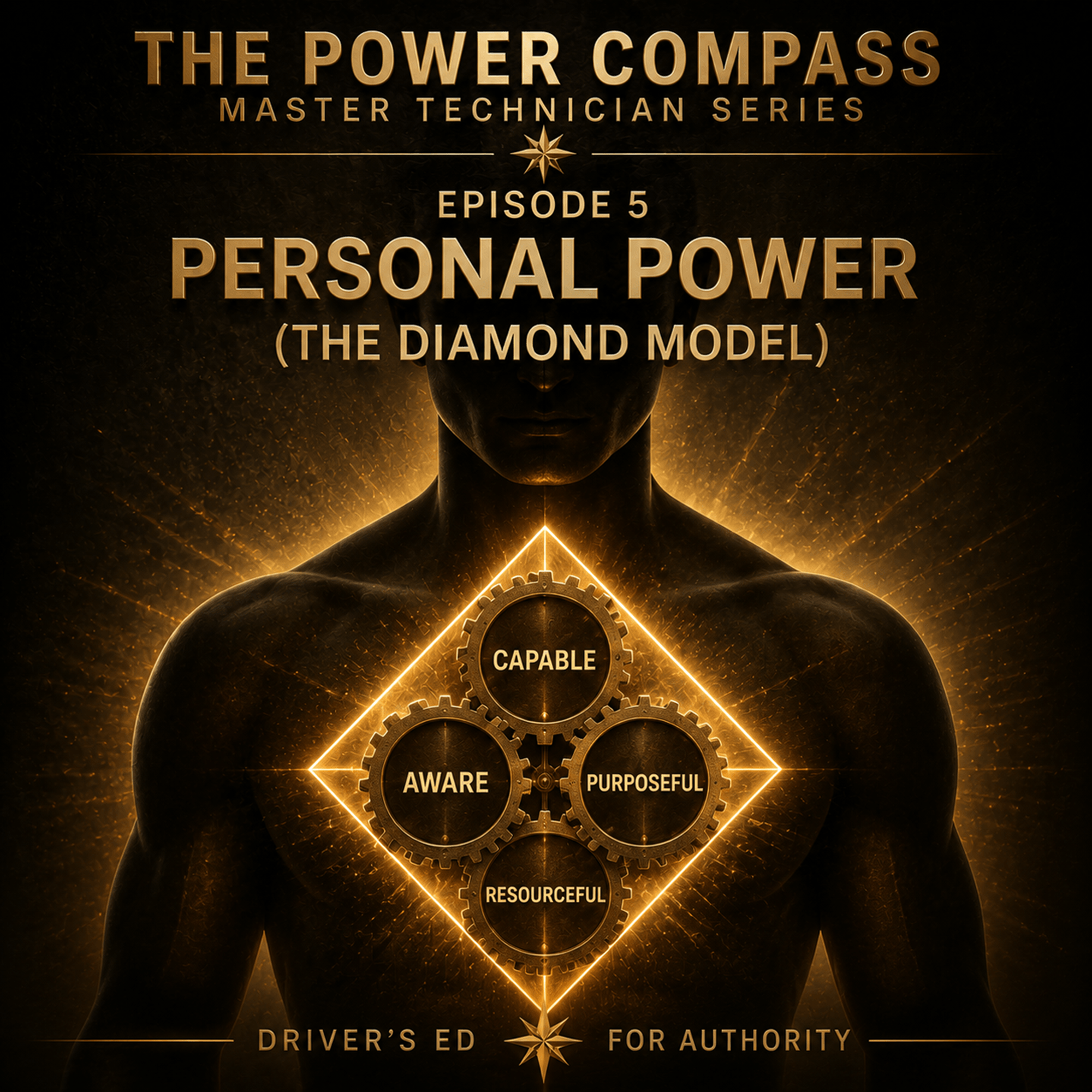
#5 What Your Sense of Self Really Teaches Us About Personal Power
The Story
What does confidence really have to do with power? The three inner domains that make personal power sustainable.Confidence isn't the same thing as personal power. Here's the three-part model that actually explains the difference.
WHAT WE DISCUSS Building on the idea of the “power battery,” this episode unpacks a three-part model of personal power — the capable self, the aware self, and the purposeful self — and why the quietest of the three, purpose, is often what keeps people steady under pressure. Drawing on Viktor Frankl's writing on meaning and some practical, borrowed-from-therapy techniques for shifting your emotional state, we make the case that personal power is buildable, not innate.
In this episode: • Julie Diamond's Diamond Power Index and its three domains of personal power • Capable self: building confidence without overinflating it • Aware self: understanding what triggers your thoughts and reactions • Purposeful self: finding resilience through a bigger sense of meaning • Viktor Frankl's insights on meaning under extreme adversity • Simple NLP techniques for shifting your emotional state • Why introverts can hold just as much personal power as extroverts
RESOURCES & LINKS MENTIONED • Dr Julie Diamond — Power: A User's Guide — https://www.amazon.com/Power-Users-Guide-Julie-Diamond/dp/0996660305 • Viktor E. Frankl — Man's Search for Meaning — https://www.goodreads.com/book/show/4069.Man_s_Search_for_Meaning • Barbara Sher (career author) — https://barbarasher.com • Dr Joe Dispenza — https://drjoedispenza.com
COMING UP NEXT Next time: why feedback so often goes wrong once power enters the room — and the three-part tool that makes hard truths land without triggering shame.
ABOUT YOUR HOSTS Dr Steve Vinay Gunther Therapist · author · organisational consultant · founder of Gestalt Therapy International. A practicing therapist since 1986, his life experience includes street theatre, clowning, community activism, and a range of businesses — including a vegetarian cafe, printing press, sign-writing business, and food coop. He founded the Northern Rivers Gestalt Institute in Australia and has been running professional therapy training in China since 2012. He has taught in many countries over the last 25 years, is director of Gestalt Therapy International, and founder of Learn Gestalt. He has practiced meditation since 1973 and was Professor of Spiritual Psychology at Ryokan College in Los Angeles. He is author of the bestseller The Woman In Your Life — A Man's Guide to a Happy Relationship, published in four languages. An accredited career counsellor since 1993, he developed a unique system called Career Decision Coaching. His PhD explored the interpersonal dynamics of power with managers across three countries.
Dr Paul Donovan Organisational consultant and trainer · executive coach · author Owner and director of The Change Company, founded in 1999. He specialises in working with senior executive teams — facilitating team building and strategy, coaching, and leadership development. That work often involves Paul assisting executives to pause their transactional and familiar conversations and examine the individual and collective tensions that are not being discussed. His research suggests these "undiscussable" topics are often among the most strategic for the organisation. Paul has worked across sectors including property development, higher education, pharmaceutical, defence, food manufacture, high-technology medical, government, consulting, and finance. He has published several research articles including a chapter in the award-winning Realising Critical HRD — Stories of Reflecting, Voicing and Enacting Critical Practice. He wrote the popular book Bosses Behaving Badly, exploring how power can be applied skilfully by those in leadership positions.
DiamondPowerIndex #CapableSelfAwareSelfPurposefulSelf #HowToBuildResilienceAsALeader #PersonalPowerForIntroverts #MeaningAndResilience
Speaker 0: So, welcome to our next podcast. Speaker 0: Dr Paul Donovan and Dr Vinay Ganthar. Speaker 0: we're talking about power. Speaker 0: We are exploring many different facets of Power And today were looking at personal power. Speaker 0: Now there's a great deal to say about Personal Power. Speaker 0: It is a great interest because it not only relevant in terms of organisations or roles its relevant in many areas of life. Speaker 0: Its really underpins the operation of organisational role-power.
Speaker 0: So today, we're going to firstly get into it by framing and in terms of three different types of power courtesy of Julie Diamond. Speaker 0: And some of her input. Speaker 0: she's written a wonderful book which we both recommend and A power user manual. Speaker 0: I think isn't yeah or uses guide that's right Yeah. Speaker 0: so let's just get stuck straight into it. Speaker 0: So Paul what's the first domain of Power? Speaker 1: Right now? Speaker 1: thank you Julie I want to acknowledge her.
Speaker 1: Now the work we're going draw on today, although we recommend a book because it's such great thought leading contribution in this area The three domains of personal power that were talking about actually comes from her proprietary tool. Speaker 1: So she has a three sixty tool which neither us have any financial stake-in just clarifying its diamond power index. Speaker 1: And so I've used this tool many, many times organizationally and one of the great aspects is that it enables an individual to get a mirror into what they have as their personal power.
Speaker 1: She does this by separating them in three domains. Speaker 1: The first domain is this capable self. Speaker 1: So capable self Is the level at which you feel confident that you can have impact on something. Speaker 1: So simply put, how optimistic are you? Speaker 1: That you could do whatever it is your task to do and if I've coached many people over the years a sense of this is really hard and its beyond me. Speaker 1: then what we'd say in first domain personal power? Speaker 1: you're scoring yourself low.
Speaker 1: there is a low capable self. Speaker 1: And we both suggest that, That IS actually problematic! Speaker 1: Now it sounds like It might be humble and maybe even useful in some contexts but the reality Is going into a task. Speaker 1: holding grave doubts about whether you can Even do it...is not helpful to bring all of yourself To The Task. Speaker 1: capable self Speaker 0: really Speaker 1: helps. Speaker 0: That's right, we were talking in a previous episode about roll power and how sometimes people don't use the rollpower that they have And it is just as problematic when you overuse them.
Speaker 0: So again this isn't a position of humility. Speaker 0: It comes out of fear or something Or being daunted. Speaker 0: The same thing with personal power When people do not own their powers They feel powerless then their sense of capacity and capability goes down. Speaker 0: don't want to encourage or support people be overinflated, because you know that's skating on thin ice then. Speaker 0: And and that also creates problems we can say in terms of peoples use the power when there is kind too much belief.
Speaker 0: their own capability. Speaker 0: so it a little bit matter at golden mean where need have a grounded believe your own capability? Speaker 0: Of course I'm therapist. Speaker 0: this something were people zone. Speaker 0: personal history often has great deal to bear, the way that power was used in their family. Speaker 0: Power is used over them whether they were encouraged to become confident or whether they would diminished and these are factors which contribute to people's sense of positivity and capability.
Speaker 0: now in this sphere of maybe personal development or motivational speaking on something there's a lot kind of rah-rah, you know? Speaker 0: You can do it. Speaker 0: David Goggins anything's possible. Speaker 0: push yourself and whilst that...that can energize people. Speaker 0: I think what we're talking about is something a little quieter and more internal.
Speaker 1: I like the way you put that! Speaker 1: It is quieter and its more internal intelligence to unquestion, unacknowledged persistent self-doubting. Speaker 1: And it suggests that such an internal thought pattern is not helpful for good use of power and as you mentioned earlier if learn and be capable in the context, which you find yourself. Speaker 1: Then you might more vulnerable to overusing that role power or shrinking back. Speaker 1: becoming victimized by a circumstance is too much for you.
Speaker 1: We want avoid either of those two things. Speaker 1: it's useful have strong sense being capable. Speaker 1: And the last thing I'd say here about this, Vinay is when i'm working with groups teaching power often. Speaker 1: I ask them to reflect on When they've used some of The other powers that we mentioned in have In the podcast. Speaker 1: so I asked them whenever you use the power Of the collective or the network? Speaker 1: Or when Have You Used your Sense of having character? Speaker 1: when have you used your sense?
Speaker 1: Of being be able to be attractive and build rapport with others? Speaker 1: And I draw their attention to when in fact they have use these powers. Speaker 1: Mm-hmm, and that gives them an increased sense of oh I can do it again and In the workshop what I often do. Speaker 1: then as I say now bring to mind a Dilemma that confronts you and let's apply one of these powers right now to how you might address it. Speaker 1: And that is a great exercise,
Speaker 0: And that's what we're on about. Speaker 0: We are all about empowering people both from a personal level, organizational or role-level because empowerment is good using your power well and wisely and effectively as beneficial to yourself and beneficial for others. Speaker 0: so this was one of the foundations in the sense I can have an impact with other people. Speaker 0: sometimes people shy away maybe particularly let say if someone introvert. Speaker 0: They may have less sense of their capacity to have an impact, although actually introverts sometimes have a stronger impact because they...they have sort-of quietness about them and they're not making a lot of noise so that when they make a contribution or when they come forward they tend be more noticed.
Speaker 0: There's the book called The Introverted Manager which you know discusses these type things. Speaker 0: You don't just have to be a bouncing extrovert To Have A Sense Of Your Own Power. Speaker 1: Yeah, I love the books on introversion and an extra version. Speaker 1: And they've been a great support to me actually being having Speaker 0: you Speaker 1: know declaring my preference for introversion. Speaker 1: It's been a Great asset. Speaker 1: and um perhaps that brings us to the second Capacity.
Speaker 1: will i mention something there? Speaker 1: yes? Speaker 0: Yes Speaker 1: The aware self yeah, so we'll just say about the aware Self. Speaker 1: it helps Us Answer this question. Speaker 1: To what degree am I aware of the thoughts and feelings that are running through my head? Speaker 1: What triggers those thoughts and feeling And to, what degree can i consciously direct My mind to The object Of choice? Speaker 1: So these These Are the two key parts of a where self You know sometimes when I'm working with people and I'll ask them does your mind?
Speaker 1: you have trouble Keeping track holding your focus on one thing, but you dash from one thing to the other and There what that person is lacking? Speaker 1: Is a low aware self unable to be to become meta to their own mind? Speaker 1: Observe where it's happy. Speaker 1: Where its going? Speaker 1: What triggering that and then being able to consciously Focus it in the chosen direction. Speaker 1: That's aware self and as you can tell, It is at a level deeper than capable Self. Speaker 1: Capable Self being how am I confident?
Speaker 1: To what degree do i believe have an impact on The outer world get traction On something move Something along? Speaker 1: that's An Outer World kind of measure A personal power. Speaker 1: now we come In one layer when We ask ourselves To what degree do I have a sense of my own mind? Speaker 1: Am i aware whats triggering my fears, my anxieties and can focus on mine consciously. Speaker 1: You were going to mention something there. Speaker 0: Yeah well you know. Speaker 0: it reminds me current popular arena which is mindfulness.
Speaker 0: its certainly popular in wider society psychology arena and of course it derives from an originally kind spiritual source. Speaker 0: So in a way, what we're talking about is sort-of mindfulness the capacity to not just self reflect but be aware at deeper level rather than being driven by our impulses as you say take a metaperspective with them. Speaker 0: now my concern is that abstract or a bit idealistic, and I certainly want to point out that this discussion of the aware self is not something you've got be an advanced mindfulness practitioner.
Speaker 0: In fact in my area Gestalt Therapy The core practice we use is awareness And it's like some sort transcendent awareness. Speaker 0: It's very simple awareness Very grounded present-centred awareness such as What do you feel in your body right now? Speaker 0: Because that's the most grounded place. Speaker 0: Or what are you aware of? Speaker 0: as you look out the window, both these questions draw people's attention to their present awareness and away from often the spinning thoughts.
Speaker 0: you know, in a psychotherapeutic process we're very interested in drawing people into their own aware self because within that lies the kind of empowerment that people are seeking. Speaker 0: In terms of the problems in our life. Speaker 0: That's certainly been my experience and my practice Speaker 1: Yes My personal experiences as well. Speaker 1: I thank You for saying that it is not abstract. Speaker 1: It has its very doable actionable strategies we can engage in to build our aware self, this second critical component of personal power.
Speaker 1: In fact one of the exercises I sometimes do with corporate groups for me when i'm looking to assist them to build a way itself is they asked him this particular set questions. Speaker 1: that straightforward really but I ask them to consider when was it time you had rank in the room? Speaker 1: You were elevated, you're in a role that had authority. Speaker 1: But you felt really frustrated, exasperated upset. Speaker 1: and so those two things are going together... ...you have some authority but you've felt in effect powerless by virtue of your feelings of frustration and exasporation.
Speaker 1: And then I asked the question So what did you do at that moment as an expression of your feelings, or frustration? Speaker 1: And often we discover the manager in this case became either very harsh Or unilaterally stopped a group conversation. Speaker 1: Or withdrew altogether from their conversations and just went elsewhere. Speaker 1: Sometimes they'd get up to walk out into the room And then I'll say, okay. Speaker 1: So now we're getting to be aware of and I'll ask them by the way what triggered The feelings or frustration that they asked him?
Speaker 1: What did they do as a result Of those feelings? Speaker 1: and Then I said so what impact might have your behavior had on those who are less senior than you? Speaker 1: What were you modeling? Speaker 1: What will you teaching them? Speaker 1: What would you telling them? Speaker 1: was the rules of the game here?
Speaker 1: And that's when they'll often say, oh wow. Speaker 1: So I just got momentarily upset about something, blew some steam off and then I felt better. Speaker 1: we went on with the meeting. Speaker 1: but in actual fact what their lacking awareness until do this exercise is What triggered my upset? Speaker 1: And whats'the impact of those behaviors i chose especially When had more freedom to act as a senior person? Speaker 0: Yeah, we've been talking previously about awareness of impact and this is part yourself in relationship, then when you operate through the lens of a roll power it can become quite distorted as you point out.
Speaker 0: And I think another aspect of this personal awareness is being aware your limitations now. Speaker 0: You mentioned three sixty before. Speaker 0: The Diamond Power Index has one way to do that But of course there's many different types of Three Sixty processors Now and the point of them Is basically To help people become more aware More aware their strengths are more aware Of the limitations. Speaker 0: So really, what we're talking about here is a particular kind of self-knowledge. Speaker 0: And the more self knowledge you have actually then...the more power you have.
Speaker 0: it's not just feeling confident and I can do things. Speaker 0: It also has sense.
Speaker 0: Where is it that I find difficulty? Speaker 0: Whereas at I need support, where do I need to get input? Speaker 0: or where do i just come up against my own personal you know ceiling Or something like that. Speaker 0: These are the kind of things we're interested in psychotherapy exploring and they're equally relevant as You say to these managers who might not have reflected on That before. Speaker 0: so your questions elicit their kind of awareness. Speaker 1: Yeah Yes, I Just want to pick up.
Speaker 1: I love what you've just said there. Speaker 1: Understanding what triggers our rambling thoughts, and sometimes our surging feelings is very powerful. Speaker 1: And it lifts out game... ...and gives us way more options in the world! Speaker 1: It's a critical part of being personally powerful. Speaker 1: Yeah? Speaker 1: That's great. Speaker 0: So let's move on to the third one,
Speaker 1: Purposeful Self. Speaker 1: What can you say about that? Speaker 1: Purposeful self. Speaker 1: So I consider this to be the final, deepest part of The Three Parts Of Personal Power like...I imagine them as a kind of concentric circles or spheres within spheres. Speaker 1: purposeful self is our sense of optimism Our sense That we Speaker 0: CAN Speaker 1: get up again after falling the sense of confidence we have that we can recover after the inevitable hiccups life brings. Speaker 1: The more you want to do in life, the more you wanna realize our potential.
Speaker 1: We are going to be bigger and bigger problems. Speaker 1: They're not gonna get smaller. Speaker 1: they probably will get bigger. Speaker 1: And...the question posed here is Can we see our lives beyond the immediate hiccup? Speaker 1: beyond the horrible failure that we've had in that meeting, or at that client he worked with. Speaker 1: To see our bigger arc of lives and to see our hiccups as a much bigger life purpose gives us a kind of meta quality for things that happen that are upsetting when we think they have failed but in actual fact are a hiccup on our bigger, bigger life arc meaning.
Speaker 0: And Speaker 1: here I encourage people to consider what is my big alive arc? Speaker 1: What am i doing here? Speaker 1: ?What's my quest? Speaker 1: ,what do i want to provide? Speaker 1: And then in doing so, we build that purposeful self and we build resilience for now. Speaker 1: It means we built the capacity to get up again after this small failings. Speaker 1: experience from one week until next Speaker 0: year sounds a bit like version of an organisational vision. Speaker 1: Yeah, yes!
Speaker 0: And this is like personal version and mission and vision. Speaker 0: the thing that keeps us going in long-term perspective as you say can mean when we fall over where we see ourselves go somewhere. Speaker 0: so there's great deal of empowerment holding that kind of vision. Speaker 0: certainly um... There something called The Vision Quest which has derived from you know native tribes or shamanistic sources where sometimes there's a writer passage, something that person might do when they come to some difficulty of trauma in their life.
Speaker 0: They'll be sent out on this vision quest. Speaker 0: so go into the desert with very little food and fast be present in nature and with themselves, there's some sort of vision that they get comes out. Speaker 0: That is part of the notion. Speaker 0: what our vision isn't just plotting a long day-by-day going for paychecks or something personal power comes from having something much more profound. Speaker 0: There are a lot indicators of health too when people have their greater sense mission & purpose.
Speaker 1: Yes, there's a whole bunch of studies on well-being that suggest that clarifying one's bigger purpose has a ripple effect across the wellbeing in your life and you capacity to realize your own dreams. Speaker 1: And I like... You have done a lot of work. Speaker 1: when I reflect routinely what is really important in my life? Speaker 1: What am doing now line up with You know, like one of my quests in life is to enable those who experience power and their roles. Speaker 1: To be able use it more consciously...to bring others..more freedom....more dignity.....more growth.
Speaker 1: And that's why I'm here with you because i know you share a similar life purpose.
Speaker 1: It invigorates the tasks we do with something deeper Values that we hold really deep and then infuse into The day-to-day actions, but where doing? Speaker 1: And this is very important part of being personally powerful
Speaker 0: Yeah. Speaker 0: Yes so I guess There might be some people listening that say, well it's all very well for you too. Speaker 0: You've got your careers, your consultants obviously doing what you enjoy doing. Speaker 0: but what about people who are a bit stuck in the job they don't really enjoy with a boss whose not that fantastic or dead end career of something? Speaker 0: Or their there because thats their original degree and its'nt really their interest. Speaker 0: so... People on that position may say this all sounds very wonderful, but how does that relate to my life?
Speaker 0: I'm just here to get by kind of thing and do the best i can. Speaker 0: And managers especially middle-level managers might also feel the same. Speaker 0: so it's important we speak too.
Speaker 0: It makes me think a bit about the work of Viktor Frankl who is Jewish psychiatrist wrote a book about his experiences in concentration camps, the Second World War. Speaker 0: Man's search for meaning has never been out of print since whenever it was printed in nineteen forty-seven. Speaker 0: and he also examines this kind of question of Meaning & Purpose from an existential point of view. Speaker 0: And what he says is that even if circumstances which are difficult or restricted That there still possible to find that sense of meaning and purpose?
Speaker 0: In fact conditions and people who didn't, is that they had some sense of meaning purpose even amidst the terrible reality surrounding them.
Speaker 0: comfortable white middle-class men who, you know don't seem to have certain kind of challenges that other people from other demographics or the country might have. Speaker 0: talking about this. Speaker 0: I think it can be relevant for anyone in any kind of circumstance no matter how difficult and limited but is possible find a set values Frankel pointed out is that sometimes it's not so much external values. Speaker 0: It's more internal values, how you might contribute to the world around you or even in a relatively uninspiring job...
...the way that you interact with people around you and bring something into your clients. Speaker 0: These can constitute a sense of meaning & purpose on smaller scale but still meaningful
Speaker 1: fabulous. Speaker 1: You know, in my life I'm in my mid-sixties now but for many years i was just working hard doing what I felt was adding value and at the same time paying trying to pay down a mortgage.
Speaker 1: so...I think there is a lot of meaning that can be made from that kind of stage one's.
Speaker 1: It's a very noble thing to want it. Speaker 1: just provide for yourself and your family if that is indeed what you are doing. Speaker 1: And I encourage people, many of the years who have got stuck in their careers as described... ...who are laboring through one day after another. Speaker 1: One of things we cover is the nobility they do look at meaning where really excellent and admirable aspects of the situation they're in, like I am working an earning. Speaker 1: And i'm providing for myself on my autonomous or perhaps from a family as well...
After honoring that we then go onto say let's see if can discover more about what might deeply motivate you with some other values that are present, may have been actually present since you were even little. Speaker 1: That had being taking shape in your life. Speaker 1: and then we begin the journey In one small way after another of shaping their lives increasingly around those deeply held values. Speaker 1: And it's a wonderful journey. Speaker 1: It won't happen overnight but there is small ways which can do just down to how do I spend my weekend time, who do i give these resources Speaker 0: too?
Speaker 1: Who shall I spend My Time With. Speaker 1: I think they're very worthwhile questions and I ask those Questions routinely. Speaker 1: it was only two nights ago. Speaker 1: I sat Down journaling today And I asked myself These Two Very Famous Questions one after the other. Speaker 1: The First Question... The first Thing is Imagine You Get Two Phone Calls. Speaker 1: The first phone call is to tell you that you've just inherited from some lost aunt or uncle, twenty million dollars. Speaker 1: It's like what?
Speaker 1: You know the second phone call was to tell me that you have contracted an incurable rare cancer and it will take your life in ten years. Speaker 1: So then you ask a question What would do now? Speaker 1: And just two nights ago, I sat up in bed and wrote out everything that i would do. Speaker 1: Then i aligned it to how im feeling my next seven days.
Speaker 1: It's a way of deepening my personal power particularly purposeful self. Speaker 1: Yeah, yeah.
Speaker 0: And also I'm in another hat. Speaker 0: that i have is a career coach of the career coaching system and I am Also engaged with people who do want to change their career and Do something different? Speaker 0: In there workplace Um and perhaps in a completely different direction and I help People make that kind Of decision. Speaker 0: they call it career Decision Coaching. Speaker 0: so That Is also I guess Another possibility. Speaker 0: as To you know, if people ask those two questions they might indeed say well actually I do something completely different and there's a number of career authors who have very much inspired me.
Speaker 0: One is the woman called Barbara Scheer. Speaker 0: she died about ten years ago, a very wonderful woman. Speaker 0: I had the honor of meeting her and learning something from her And she's written some great books...I recommend any of these books because She is an ordinary person with a soul parent With couple young children living in New York. Speaker 0: You know. Speaker 0: they come form high flying position. Speaker 0: So what she writes about? Speaker 0: it' s very realistic Very gritty At same time encouraging people to really open up a sense of possibility with what they're doing their life and to step outside the blinkers, or what have been told as possible.
Speaker 0: Or what they've believed is possible And consider enormous opportunities that might otherwise go. Speaker 0: no thats too much That's too impossible. Speaker 0: So yeah I very recommend her books for this purpose. Speaker 0: To think about how your work may be aligned. Speaker 0: I
Speaker 1: love hearing you say that. Speaker 1: I feel inspired just hearing it and It reminds me sometimes in the work, i do around these three aspects of personal power from Dr. Speaker 1: Julie Diamond? Speaker 1: Okay so if I built my capable self or If I just allowed myself to experience momentarily Myself as being more Capable than perhaps what I might on your every day moment. Speaker 1: And then In That context How might that enrich my vision for my purpose, full self? Speaker 1: And so I fold them in on one another and enrich each one by doing it.
Speaker 1: So they can be folded-in and overlapped routinely woven together to deepen this sense of personal power. Speaker 1: When we have that personal power vulnerable to misusing power in other ways, uh...in our workplace because most misuses of power are derived from anybody including me or you and anyone else when we're really lacking the experience being personally powerful. Speaker 1: Exactly! Speaker 1: And that leads actually if I might just mention it i think a fundamental goal personal power is to be able choose your state and not just have it thrust upon you by external circumstance.
Speaker 1: So to choose your state, And take action out of that chosen State That is the quintessential outcome Of building personal power...and that Is life changing.
Speaker 1: Can we when encounter great challenges avoid being caught up in feeling victimized or overpowered, Or just held ransom by a mind that can't control itself for. Speaker 1: Or completely dominated in our thinking By the failures we experience one day and next And losing the big picture Can overcome it? Speaker 1: That's what personal power is.
Speaker 0: Input from NLP, which talks about changing state. Speaker 0: Yeah You know and the possibilities of doing that but There's some very interesting techniques Which allow you to change state? Speaker 0: And I remember when i first learned nlp a long time ago in the nineteen eighties. Speaker 0: one Of the things we were taught was too use what they call an anchor for a change your states. Speaker 0: so They were preparing us to like give a public talk. Speaker 0: and they're saying you know You need to change your state from your normal kind of relaxed or kind of casual self too To kind of higher energy, and you can feel your spine straight And you know you breathing more fully?
Speaker 0: And you're allowing that your energy to move through your body. Speaker 0: You've got it moved to different states. Speaker 0: So what our trainer did is she said choose something that is an anchor as they call it a little trigger. Speaker 0: and for me, It was just sort of like kind of gently slapping the side of my knee. Speaker 0: And I use that ever after when iI was stepping into Like A big meeting or An important Meeting ,a Big event . Speaker 0: I Just do That. Speaker 0: It shuts The Side Of My Knee & I Feel Myself Moving Into That State!
Speaker 0: It Was Like A Switch Which Went On. Speaker 0: So There's Some Great Techniques on That Front. Speaker 0: The you know Norman Vincent Peale and the power positive thinking is kind of over a hundred years old now. Speaker 0: so There's some interesting research, which I think you and I will go into at another point However. Speaker 0: I want to mention it here in terms of personal power And says lot of research been done on power Mostly this sort of experimental settings where that they do things like what they call a power prompt.
Speaker 0: They say, imagine that you have a lot of money or imagined that your the boss and then they observe people's behavior in different circumstances all their answer questions or something just based on these prompts which are like sort of personal empowerment. Speaker 0: but there kind of your own mental shift And what they observed as both of us have read is this small shifts little imaginative pieces actually change people's behavior quite dramatically and observably, inconsistently. Speaker 0: So it is quite amazing just how much this sort of sense or personal power even if you imagine yourself more powerful than your are.
Speaker 0: its not a silly fantasy that these things do influence us in the way we behave in our world? Speaker 1: Yes! Speaker 1: Absolutely You know. Speaker 1: as dr. Speaker 1: Joe Dispenza says and others have said change your state Change, you're life And if we can. Speaker 1: in fact this is one of the primary messages really in at the whole forty two years of Tony Robbins work Is? Speaker 1: The power-of-state management and I am an ant and has it turns out It is really at the essence of building personal Power Is to be able to choose your state, To change a State when it's no longer useful for you.
Speaker 1: When the State No longer lines up with The outcomes that You want to create then It is Useful to literally Change Your State and That can Be done simply by imagining something. Speaker 1: as You've just said its Just A game that we play to enable us, to come into the state which most supports in our chosen goal and our chosen behavior. Speaker 1: The one that's going to enable as effective ,as compassionate . Speaker 1: As fair as we want be in any circumstance. Speaker 1: I think personal power is just at the essence of it.
Speaker 1: In fact, maybe if we could suggest a couple of things that I can mention on this Vinay.
Speaker 1: In my working with many people over the years have come. Speaker 1: to conclude there are two supplementary beliefs which seem to support sustained high personal power and those who've actually been measured to use power beautifully are this. Speaker 1: The first one is that life is inherently good and I can find a benevolent intelligent hand in it, That Life Is Here To Support Me In My Growth In My Becoming And Those Who Exercise Higher Personal Power Seem To Cultivate That Belief Over Time that life is inherently good, it's oriented toward me in a benevolent fashion.
Speaker 1: And I think this is the first and second belief – that I am inherently worthwhile! Speaker 1: That even though I might do bad things from time to time my worth a superficial read of my behaviors, that I have worth. Speaker 1: that's beyond that. Speaker 1: That i'm valuable and worthwhile And each human being that I interact enjoys the same profound sense Of value.
Speaker 1: Those two beliefs seem to support The practices of building personal power And I cultivate them in my meditations. Speaker 1: I actively put myself into a state where I believe, and I'm entertaining the notion that life is here to support me in my becoming... ...and I routinely take on that posture inner meditation then relook at my life and wonder what's possible now? Speaker 0: It's great you hear that! Speaker 0: It sort of takes us in what you could call a more spiritual direction, but not necessarily the direction some even belief and higher power.
Speaker 0: But it's some belief nevertheless or faith as people often refer to these days that there is a kind of synchronicity despite suffering things that happen to us, they're terrible and damaging. Speaker 0: And painful and demoralizing. Speaker 0: it's part of that purposeful self in an even larger sense than there is the even larger purpose for all this. Speaker 0: Yes! Speaker 0: That can also indeed be a source of empowerment. Speaker 1: I think these beliefs seem to be useful. Speaker 1: you see i'm speaking to the utility of them as opposed to whether their are actually always true.
Speaker 1: What I notice is, I'd rather not ask the question. Speaker 1: Is it true? Speaker 1: It isn't not...I'm saying actually these beliefs seem to be highly effective To enable me to live well and to be effective in my life. Speaker 1: so i choose those beliefs
Speaker 0: Fantastic, well I guess that's a good place to leave it for today. Speaker 0: Thanks very much always stimulating enjoyable discussion with you Speaker 1: and Speaker 0: cover the ground of personal power. Speaker 0: there is lot more we can say about this introduction. Speaker 0: see everybody next time.
 Apple Podcasts
 Castbox
 Castro
 Goodpods
 Moon FM
 Overcast
 Pocket Casts
 Podbean
 Podcast Addict
 Podcast Republic
 Spotify